

Once again, it’s time to discuss some music trading cards, and today’s featured set is Yo! MTV Raps by Pro Set.
For those that don’t collect trading cards, Pro Set was a company that entered the trading card game as a maker of National Football League (NFL) cards in 1989, and eventually expanded to sports and leagues such as the National Hockey League (NHL), Professional Golfers’ Association (PGA), and English League football. In spite of my own strong nostalgia for some of these cards (particularly the hockey ones), it must be said that many of these sets were horribly riddled with errors that ranged from including the wrong picture of an athlete to providing the incorrect statistics on the back or misspelling names. To put the amount of mistakes in greater perspective, their 1990-91 NHL set contained notable mistakes on around 15 percent of the set’s cards (106 out of 705). View the Pro Set Wikipedia page for a list of several examples of their blunders, which included misspelling Hockey Hall of Fame defenseman Ray Bourque’s name on the very first card, as well as some insights into the company’s 1994 bankruptcy.
Pro Set must have noticed the relative lack of trading cards in the North American market that centered around music, so in 1991 stepped up to fill the void with a set called SuperStars MusiCards, which combined artists of several different genres, from Maxi Priest to Metal Church, from Simple Minds to Screaming Trees. I’d imagine that Pro Set (sometimes listed as ProSet) would have been aiming for a whole annual lineup of cards to feature the latest and greatest goings on in music as they did with professional sports, but for some reason they didn’t take off and were discontinued. I may have some more thoughts to add about the SuperStars set at a future date, but for now I’ll refer you to this enjoyable blog on the same topic where he’s continually going through the set one card at a time.
The other music set they released in 1991 was more genre-focused, and specifically focused around the framework of a television show. Yo! MTV Raps was a programming block that MTV that aired between 1988 and 1995. IMDB lists that 47 episodes aired, while Wikipedia states a whopping 1,838, which would be much more understandable as the show did shift to a daily thing rather than just a weekend or occasional show. Much like the similar MTV program for hard rock and metal Headbanger’s Ball, the show was a bit before my time, and being Canadian I wouldn’t have been able to easily watch it either. Thankfully, I have spotted several episodes of the program on YouTube and other online video platforms, so a good sampling of the show is still available for those of us that missed out. A vh1 RockDocs documentary was produced that describes the show better than I ever could do, and these trading cards even get referenced in it! That goes to show you how big a deal it was at the time to get yourself printed on a trading card back then.
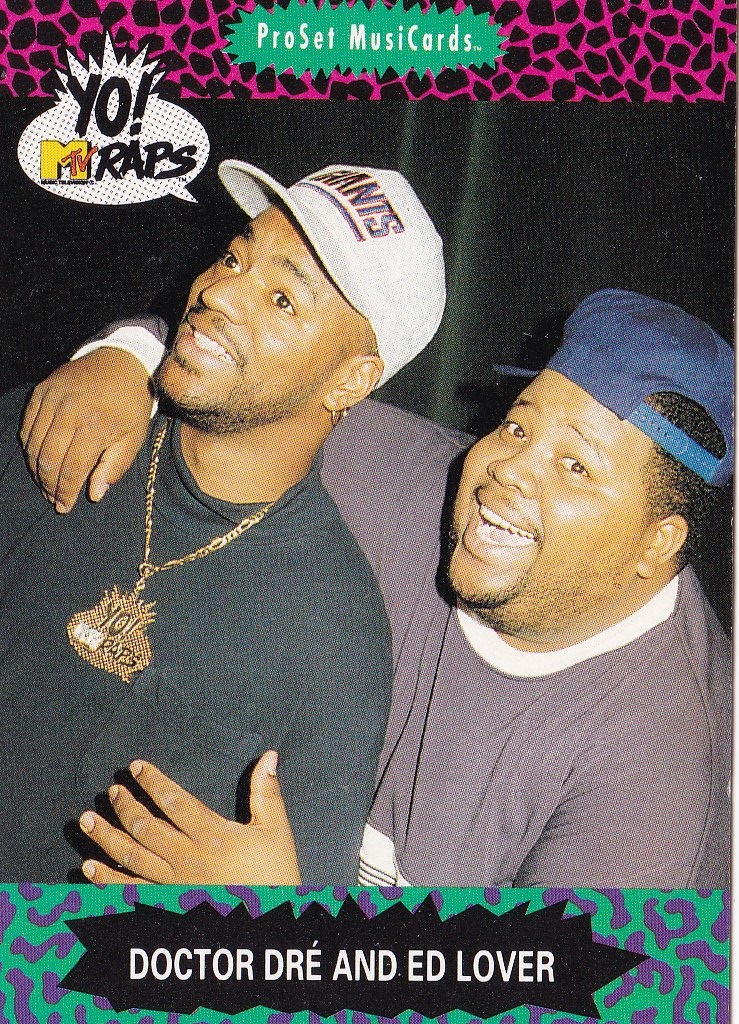
The style of this set is not remotely close to any of their sports card designs that I’ve seen, but the use of colour (and the fact that these are not athletes) make them stand out from my collection in a fun way. On that note, what do you call that green and purple blotchy background on the bottom border? That sort of motif seemed so prevalent in the early-’90s. My mind drifts to Nickelodeon TV shows like Rocko’s Modern Life or Rugrats in their layout choices. It does fits the aesthetic of the show’s intro sequence nicely, so not out of character at all. Plus, when you watch the skits that Doctor Dré and Ed Lover often performed between videos, you can see the cartoon connection as they kept it light-hearted. That fun often extends to the back of the cards too. In the hosting duo’s case, their (record) label was printed with descriptors ranging from “they avoid labels” to “they only read those on JAM jars”.

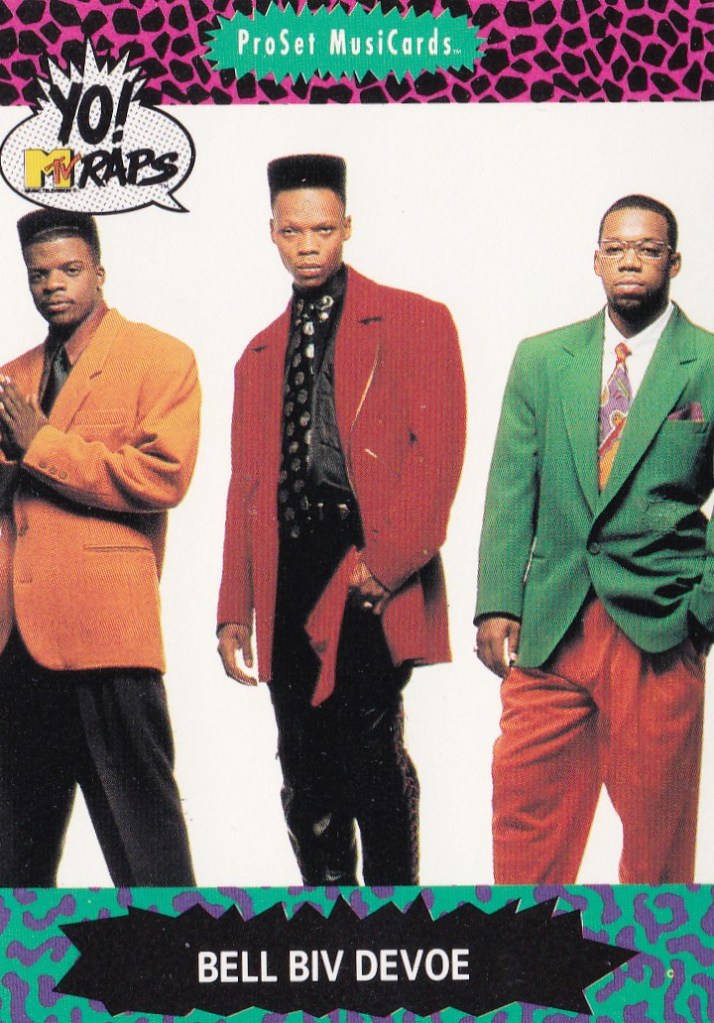
The centrepiece of these cards, as is the case for most sets, is the photographs. Despite the relative lack of variety with most of any given artist’s pictures, the contrast between visual styles between different performers is quite evident. Here, we have Bell Biv DeVoe, with the man on the left in the card below (Ricky Bell) either going for that Christian dollar with his hands folded in prayer or attempting to beat that Spice Adams hand-rubbing meme to market. They’re a rare group here that refused to be pigeonholed into a corner visually, the whole band seems to have a great assortment in how they dress, which I’m not sure is cool or confusing. I’m just not used to seeing music groups behave this way, but 1991 was a different time, and I guess I wasn’t paying that much attention as a six-year old. Speaking of which, shame on me for forgetting that it was these guys that were filming a music video in the Banks’ house on that one episode of The Fresh Prince of Bel-Air!
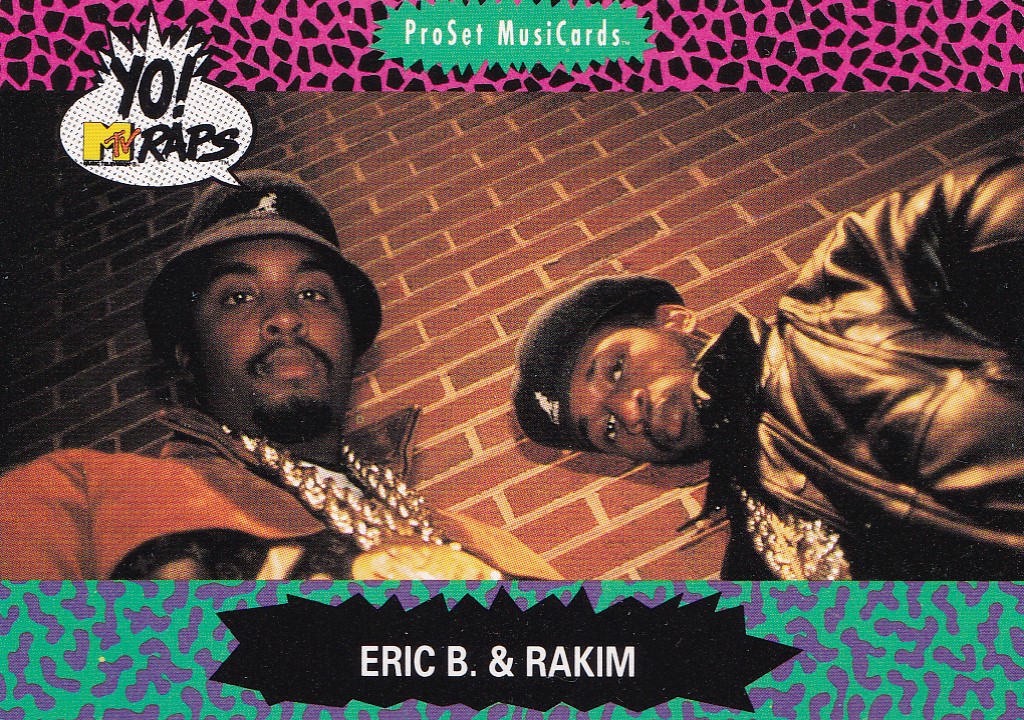
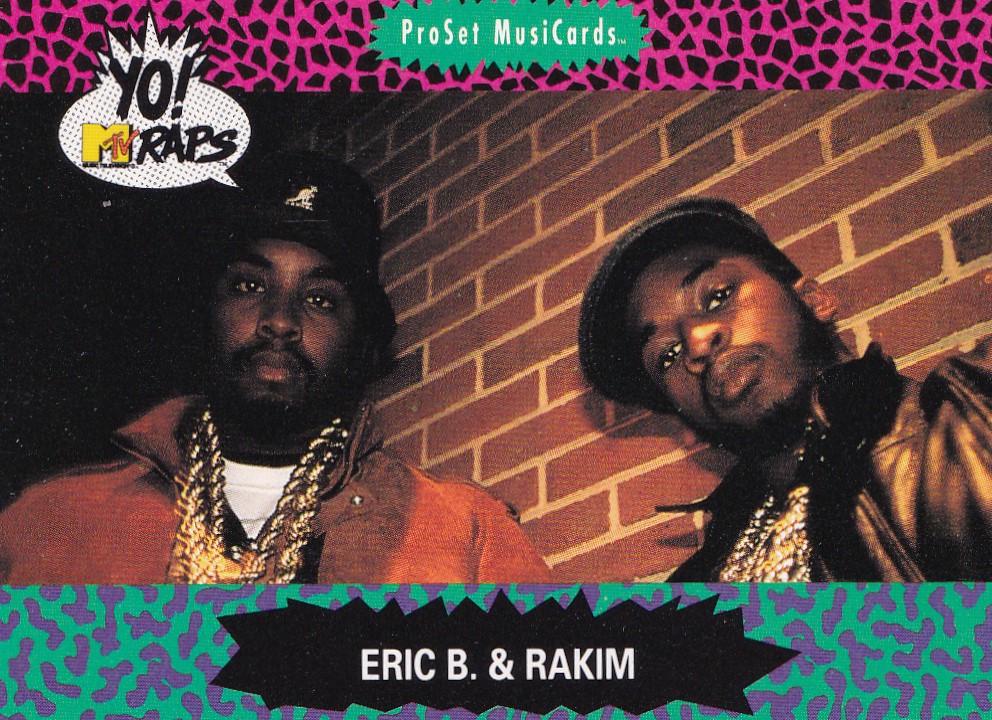
Pro Set seemed to have a rather limited range of photographs to choose from, which is impossible to hide in a 100-card set that features 32 different artists total (29 if you count the Chuck D, Flavor Flav, and Terminator X cards as Public Enemy ones). Take at look at these two cards of Eric B. & Rakim as an example, likely taken seconds apart.
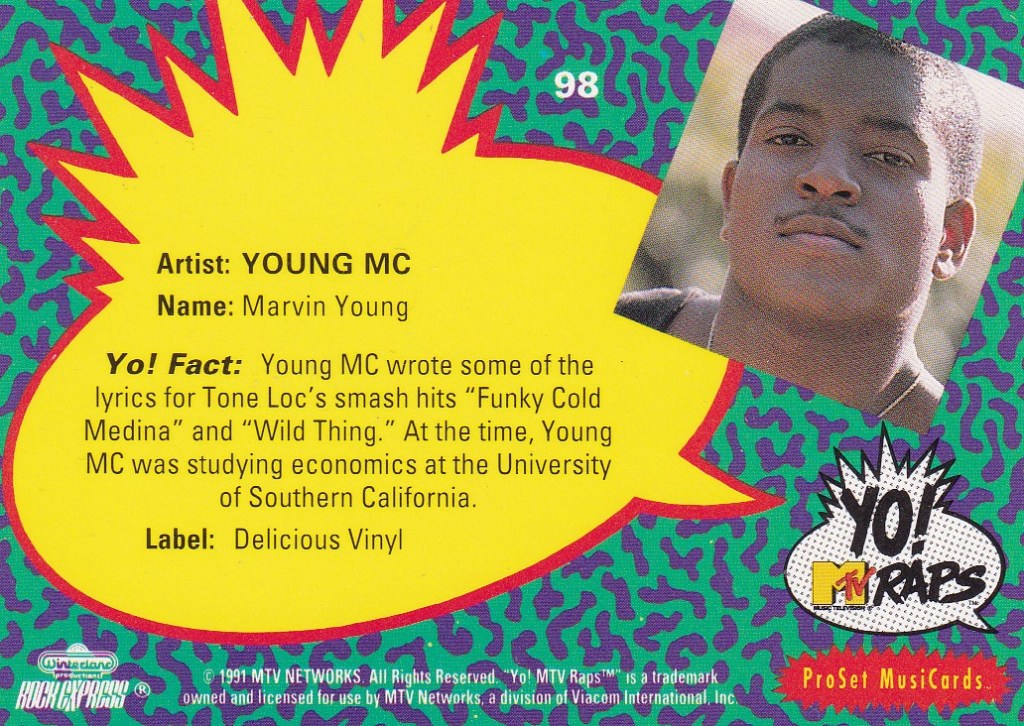
Photos that appear on the front of some cards tend to appear on the backs of others. This was particularly easy to catch when looking at the Young MC cards, where this photo recycling happens between each of his four cards, as the front photo on one card is identical to the back photo of a previous one. The two below, for example, are from two separate Young MC cards in the set.

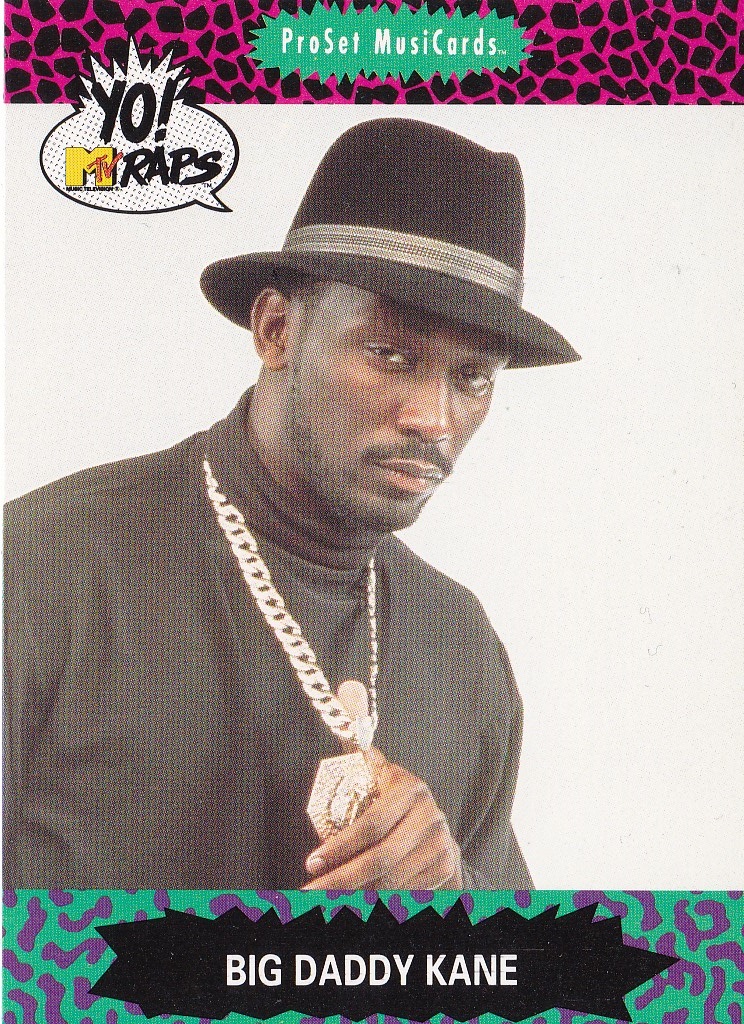
Now back to a few cards that I do enjoy. Big Daddy Kane had a look that he could not be messed with. Venturing into the Bell Biv DeVoe wardrobe variance across his photos, he always stands out looking like the coolest person in the room. Card number 8 in the set is a great example of that. The back of the card makes mention of a new home video of his that was set to be release, but there’s a notable lack of information about it, not even a name (it was likely Chocolate City, one of his movie appearances, or something else that never came to fruition). Pro Set may not have been privy to the name as they had a print deadline to hit. Mr. Antonio Hardy doesn’t appear concerned though, as we see him looking very certain that you’ll find that video and recommend it to all of your friends.
While they are among the more established of the artists in this set, I applaud that Run DMC are shown with their current look of 1991, around the time where they began to shift away from the matching Adidas gear and updated their sound. You get their previous look as well, but this shows that this was one key aspect of the featured rappers that Pro Set were paying attention to.

The odder, the better for me when it comes to certain trading cards. Could someone tell me what is going on with this Vanilla Ice card?

Push-ups? Break-dancing, perhaps? Prepping for a sex scene in Cool As Ice that I didn’t know existed? Whatever the rationale, I’m glad this card captured it! If anybody out there saw him live at his commercial peak, let me know if he pulled this move off at the show you attended. Better yet, if you’ve seen him lately, let me know if he can still pull off such a move.
Along with Dré and Ed, the other most noteworthy on-screen regular with Yo! MTV Raps was Fab Five Freddy.

This was the finest of the Fab Five Freddy cards in the set, in my opinion, as we see him above in contemplation. Among the older and longest-performing of the men in this set, I like to think that he is pondering the future of rap music, which is a mandatory thing to consider in his own role on MTV Raps. Like the other two hosts of the program, Freddy also has humorous lines for his “Label” designations on his card backs, going with “Host with The Most”, “Calls ‘Em As He Sees ‘Em” and “‘FAB’ says it all!”
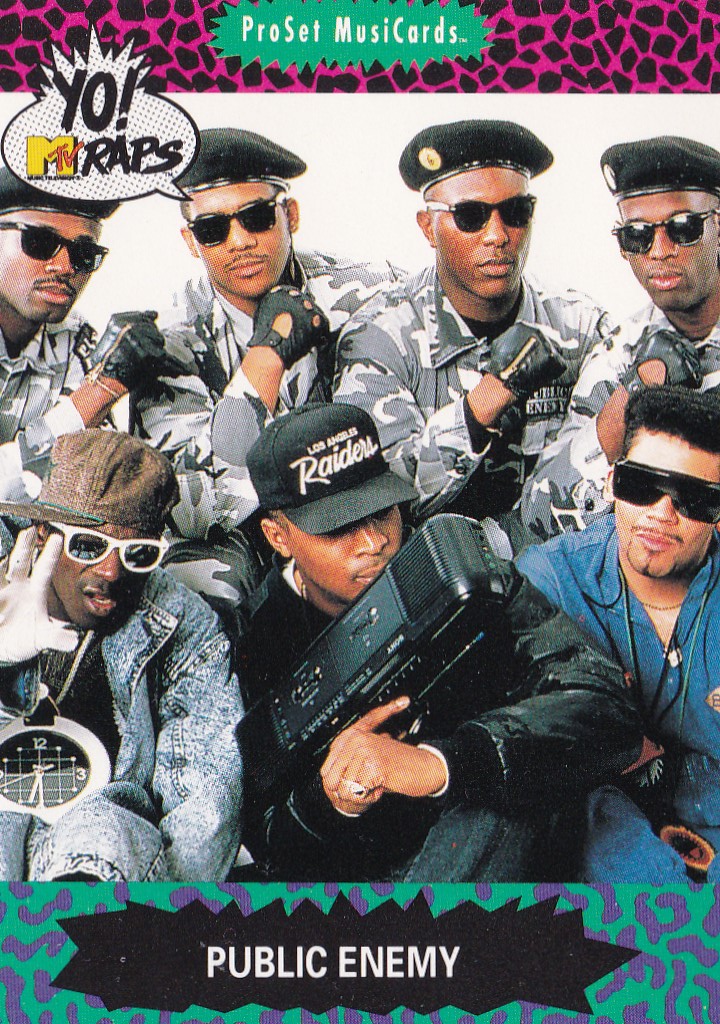
Of note, Bell Biv DeVoe leads off the set in numeric order, and the rest of the cards go in alphabetical order up to a certain point. Following the Run DMC cards, we take a jump back to Paris, then back to Slick Rick and onward in expected order. When I bought it at the flea market, the Public Enemy card I shared at the top of this page (card #63) sat on the top in a likely attempt to draw more eyes to it.
While card fronts are what draw the eyes, they print content on the backs for a reason. Naturally, I flipped the stack over and read each of them not just to check for the errors that Pro Set was prone to make, but as a method of education (which is much more important). Still, I’d hate to read up on a guy only to find out that what I did read was inaccurate, so did I catch any notable errors on these cards? Nothing major jumped out on the fronts, particularly stuff like spelling errors or having a photo that doesn’t match the artist in question. Going card by card, the language used seems a bit simplistic and non-specific in general, making the timeline of certain events as they are listed not very easy to verify or disprove without a great deal of research. There are many times, for instance, where the words “got his start” are used in cases where doubt could be cast. The term can mean anything from when you wrote your first rhyme to when your debut album came out. For example, a Biz Markie card states his was as the human beat box for Roxanne Shante. He technically beat her to market with his debut album Goin’ Off, which was released a year earlier than Shante’s Bad Sister. However, Biz’ own website’s bio section does confirm that his “music scene debut” was, in fact, in the card’s stated context with her Juice Crew. It seems that in his case, when they meant start, they meant it from a career perspective. While I hoped to learn of some earlier demo or group of his own, I wasn’t able to cast doubt on this one.
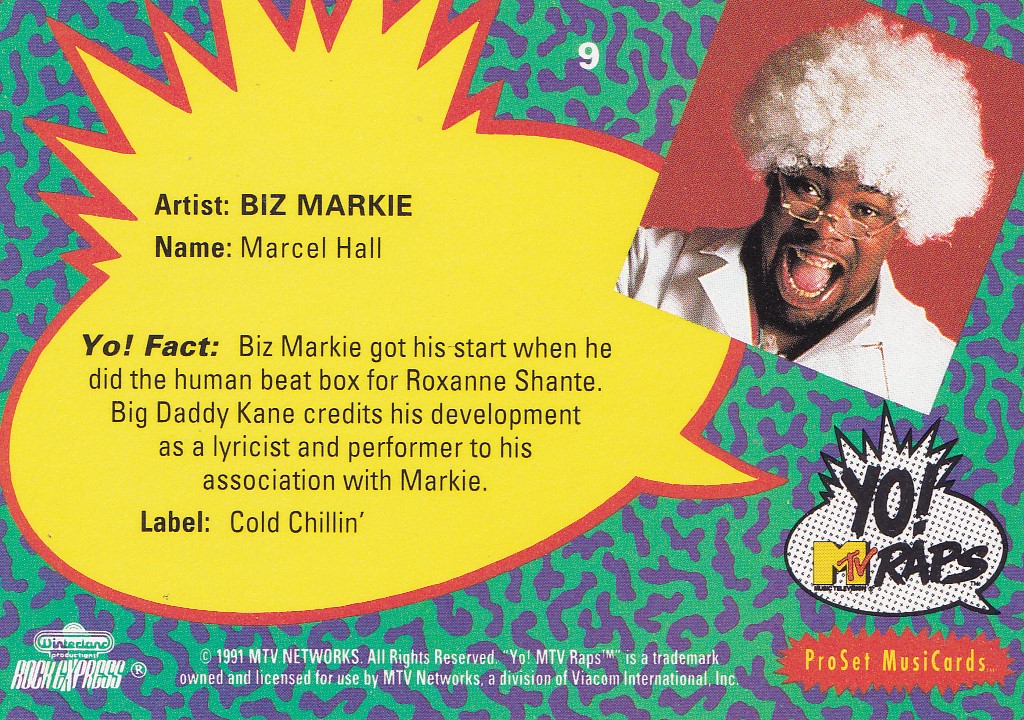
This should have made me give Pro Set’s fact-checkers more credit. It’s not as if the same people who worked the sports cards necessarily worked on their music ones. It can be hard to refute them, and the Biz Markie card is just one instance where I tried and failed. I persisted at times to the point of being overly nick-picky. It got to to the point I was looking into things such as a quote on a De La Soul card attributed to a critic (who was unnamed) saying they are “radically unlike any rap you or anybody else has ever heard”. That was actually verifiable by Google to be a quote from Robert Christgau, but a name would have gave more credence to the statement. While that was strike two against me, there was yet a third attempt to fact-check that left egg on my face. On card number 24, it lists EPMD’s Business As Usual featuring an LL Cool J appearance, but the card didn’t find it necessary to mention that there was not one, but two appearances by Redman on the album. It would have been a major mention for the time given he had yet to release his first solo album Whut? Thee Album or begin his duo with Method Man, but he got on two songs, “Hardcore” and “Brothers on My Jock”. I was ready to jump all over this oversight in missing out on anointing Redman as a star on the rise, but once I flipped two cards further to number 26, I realized I had jumped the gun. That card mentions that Erick Sermon will be producing the “new rapper”. This set is more hip that I realized!
At that stage, I gave up my skepticism and figured I’d report on only things that looked painfully wrong. I was thinking that all hope was lost, but then stumbled across the following legitimate mistakes and oversights, which I have sorted by card number:
15-18: Digital Underground’s cards list DJ Fuze as “Fuse”. However, he has been credited on certain recordings with that spelling for likely similar reason as to why whenever I write one of these pieces I get that squiggly red line under a word or two in every other line of text: spell-checkers don’t like proper nouns! This is an understandable lesser sin, but it would have been more unforgivable if they listed Schmoovy Schmoov as “Smoothy Smooth”.
27: Eric B. & Rakim’s breakthrough 1986 hit was “Eric B. Is President”, not “Eric B. For President”. This card and each of the Eric B. & Rakim cards, also list Rakim’s real name as William Griffith (it’s Griffin).
30: Eric B. & Rakim’s debut is listed as being from 1986. In fact, Paid In Full was released on July 7th, 1987.
31: Eric B. Is listed as producer of Freddie Foxx’s debut album The Master from 1990. The artist goes by Freddie Foxxx on The Master, which is a single on his actual debut album Freddie Foxxx Is Here that was released in 1989 (as was the single). A similar misspelling and defining a single as an album was made for Bret Lover. His name was spelled with an extra letter in his case (“Brett”) and the album that “Tell Me” was from is Time To Make Love.
35: Fab Five Freddy did direct Gang Starr’s “Just To Get A Rep” video, but their moniker is mistakenly stated as “Gangstarr”. Brand Nubian (with their Fab Five-directed video “Wake Up”) are mistakenly pluralized as “Nubians”.
37-40: Heavy D and The Boyz’ cards each list then-recently deceased Trouble T-Roy’s name as “Troy Dickson” (it’s Dixon).
41-42: Kool Moe Dee’s name is written as “Mohandas Deweese” (the surname is actually Dewese).
43: KRS-One’s name stated as Kris Parker. “Kris” was what he was known as, but was born Lawrence Parker. An interesting evolution of his name, as told in this hiphopdx.com article, started from being given the nickname of “Krishna” and it evolving from there.
44: LL Cool J’s birthplace of Bay Shore, Long Island is spelled in the single word “Bayshore”. New Yorkers, is this acceptable? I’ll let it slide on your say-so.
46: Claims LL Cool J was Def Jam’s first artist and “I Need A Beat” the first Def Jam single. Rick Rubin’s punk band Hose had the honor of the label’s first couple releases. As this was a label founder’s band, technically there may not have been a formal signing of the label until LL. Wikipedia clarifies LL’s single and the Beastie Boys’ “Rock Hard” were the first with catalog numbers. The Def Jam web site’s 40th anniversary declaration states T La Rock’s “It’s Yours” as the label’s first 12” rap single.
54: The sneakers MC Hammer endorsed are British Knights, not “British Knight”.
57: I couldn’t find verification on the sales figures for Oaktowns 3.5.7’s “Straight At You” as gold-selling, but this is mistakenly called an album rather than a single. The song features on their full-length debut, 1989’s Wild & Loose.
60-65: Only lists Chuck D and Flavor Flav and their real names, but excludes Terminator X (Professor Griff left the group in controversy in 1989). While he does get a card of his own as the other two did, I wonder why he was excluded from this one. In either case, they did not list him nor his real name on his card (Norman Rogers), but I admire that on card 77 they keep the mystique going with his name listed as “Only the Terminator knows for sure…”, a nice bit of stylistic flair. Still, it feels wrong that he’s excluded considering the Stetsasonic card lists all members without including their real names.
64: “The Bomb Squad” production team of Public Enemy is listed as Chuck D, Hank Shocklee, Carl Ryder, and Vietnam Sadler. Chuck D and Carl Ryder are the same person (Chuck used it an alias that derived from his real name). Keith Shocklee, who credits his jazz upbringing as a partial influence on his production mindset going into It Takes A Nation Of Millions To Hold Us Back, is not listed among them.
74-75: Super Lover Cee’s proper name is Caliente Fredericks, not “Calente”.
78-79: 3rd Bass’ DJ Richie Rich is another unfortunate one left off one of the “Name” portion of the card. Methinks the Pro Set team had something against turntablists, don’t you?
81: Three Times Dope’s debut album is listed as 1990’s Live From Acknickulous Land, but was actually 1988’s Original Stylin’.
91: Vanilla Ice was born on Halloween of 1967, rather than the stated 1968.
Any weak inclusions in the set? There are multiple LL Cool J cards, which makes sense given his popularity, but did they have to include such a blurry image on the front of card number 47?
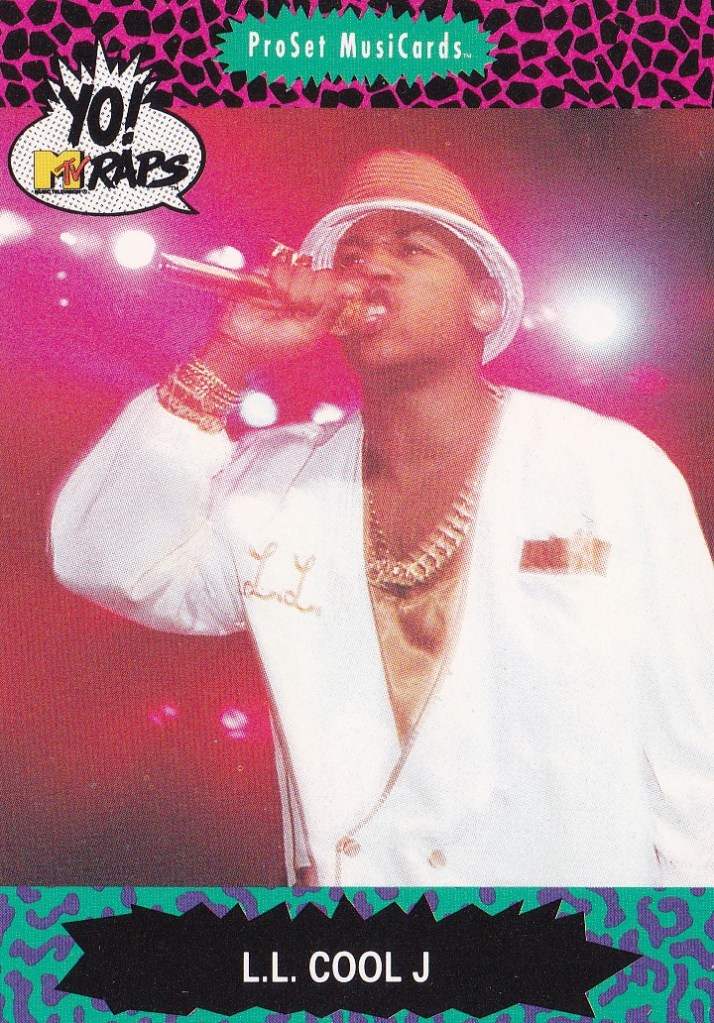
I realize that this may have been a rather nice photo at one point, but an error was made on these during the printing process. There’s a concert photo of him on another card that is also looking rather pink and hazy, so this also may have been an attempt to include imagery that felt more genuine, like something a fan would have taken. As an occasional amateur concert photographer, I’ve got plenty of keepsakes of my own that nobody in their right mind would think of publishing. I can relate, but I’ve got a convenient excuse: I’m using a Samsung Galaxy A53 phone. Whatever this photographer used here can still beat the snot out of that with its lens cap still on, so no matter the reason for this photo’s appearance, it’s a bit disappointing that this image seems to have the same flaw on every picture of the card I’ve seen.
A card was also included to highlight show producer Ted Demme, on which it notes that he has never written a song. One might think a behind the scenes guy with no music performing career whatsoever shouldn’t have got a card, but I’m not about to speak ill of a man who brought a beloved show to life, especially after hearing this touching tribute to the late producer by Ed Lover (calling him “the coolest white boy I ever met”). For cuts in a set like this to happen, you should look towards the seemingly redundant ones. The largest contributors to the set in terms of quantity are Eric B. And Rakim (5 cards), L.L. Cool J. (7), MC Hammer (8), Public Enemy (7, 10 when including individual cards of each member), and Vanilla Ice (8). No other artists exceeded 4 cards in their respective share of the set. However, if the set was capped at 5 cards per artist, this would have freed up 13 more cards that could have been used to showcase a few more artists.
Who could have been included in this set that was not? Well, to answer this question properly there was something important that I needed to consider. I recently learned that the set I purchased was not actually the entire set. Update packs were issued that expanded the set up to 150 cards, but this wasn’t exclusively used to put in artists that were missed. You could call what I bought Series One out of two series. While you did get the likes of The Beastie Boys, A Tribe Called Quest, and Queen Latifah (along with a number of other previous exclusions) appended to the set, additional cards of Fab Five Freddy, Ed Lover and Doctor Dré, Heavy D and the Boys, Kool Moe Dee, Slick Rick, and 3rd Bass were also included.
One should also take into consideration other mainstream music trading cards from that year. Excluding the number of artists that were covered by the set out there that I previously touched on in Premier Rap Pack from the same year, I still do not see Jungle Brothers or Del Tha Funky Homosapien for some notable ones that didn’t make any of the 1991 sets. I will admit that as Del slid in with his debut album on October of 1991, trying to include him may have been too late in the development of these cards to have made the cut. For that matter, we were also a few years away from giants of the genre like Tupac, Snoop Dogg, and Wu-Tang Clan to make such sets expand to legendary status. A real shame, if you ask me.
Given your own knowledge of rap from this era, or of Yo! MTV Raps for that matter, who can you think of that missed out in this set?

I’ve enjoyed opening the main Pro Set SuperStars packs back in the day, but would I say these cards are better? Not really. Both may look a little dated and all, but they are a cheap bit of fun in their own right. Certainly worth the five dollars I paid for the first series, anyway, so it’s definitely worth buying as a curiosity that won’t break the bank. You may learn far more on the internet than what can fit on a card back, but they weren’t exactly selling hip-hop encyclopedias door to door either. Cards like these were the next best thing to subscribing to a music magazine that covered rap, not to mention actually having MTV as part of your cable package.
I learned plenty in my small time looking these cards over, such as the birth of MC Hammer’s nickname, which was given to him when he was batboy with the Oakland Athletics by the Milwaukee Brewers’ Pedro Garcia (he spotted a Hammerin’ Hank Aaron resemblance in the boy), and Tone Lōc’s apparent boxing career that took him as far as the Olympic trials. I’ve yet to verify the latter as fact, but here’s a pic I spotted of him posing with Mike Tyson. The very idea that this set sparked such curiosity in me to dive deeper into the history of these artists, even if I’ve still got a few unsolved mysteries, left me with no regrets.
These Yo! MTV Raps trading cards are about as common as an AC/DC song on classic rock radio, so it won’t take much effort to keep a look-out for them.
 Armchair Maestro
One thought on “Yo! MTV Raps (Pro Set MusiCards)”