

AC/DC’s Back In Black. Van Halen’s self-titled debut. Guns ‘N’ Roses’ Appettite for Destruction. Deep Purple’s Machine Head. Some of the best-known (and best-selling) rock albums of all time, each of them oft-considered to be their finest respective recorded works.
Led Zeppelin is one of those bands that does not have a universal “best album”. Some point to their fourth record (commonly called Led Zeppelin IV or Zoso) for housing many of their biggest tracks in “Black Dog”, “Rock and Roll”, and the epic “Stairway to Heaven”. Others point to their self-titled 1969 debut, which not only kicked in eardrums worldwide with the raucous “Communication Breakdown” and “Good Time Bad Times”, but intrigued listeners with their trippy, concert-anchoring “Dazed and Confused”. I hear compelling cases made for many of their albums, usually beginning with the first album and leading up to the album I’m featuring today: 1975’s Physical Graffiti.

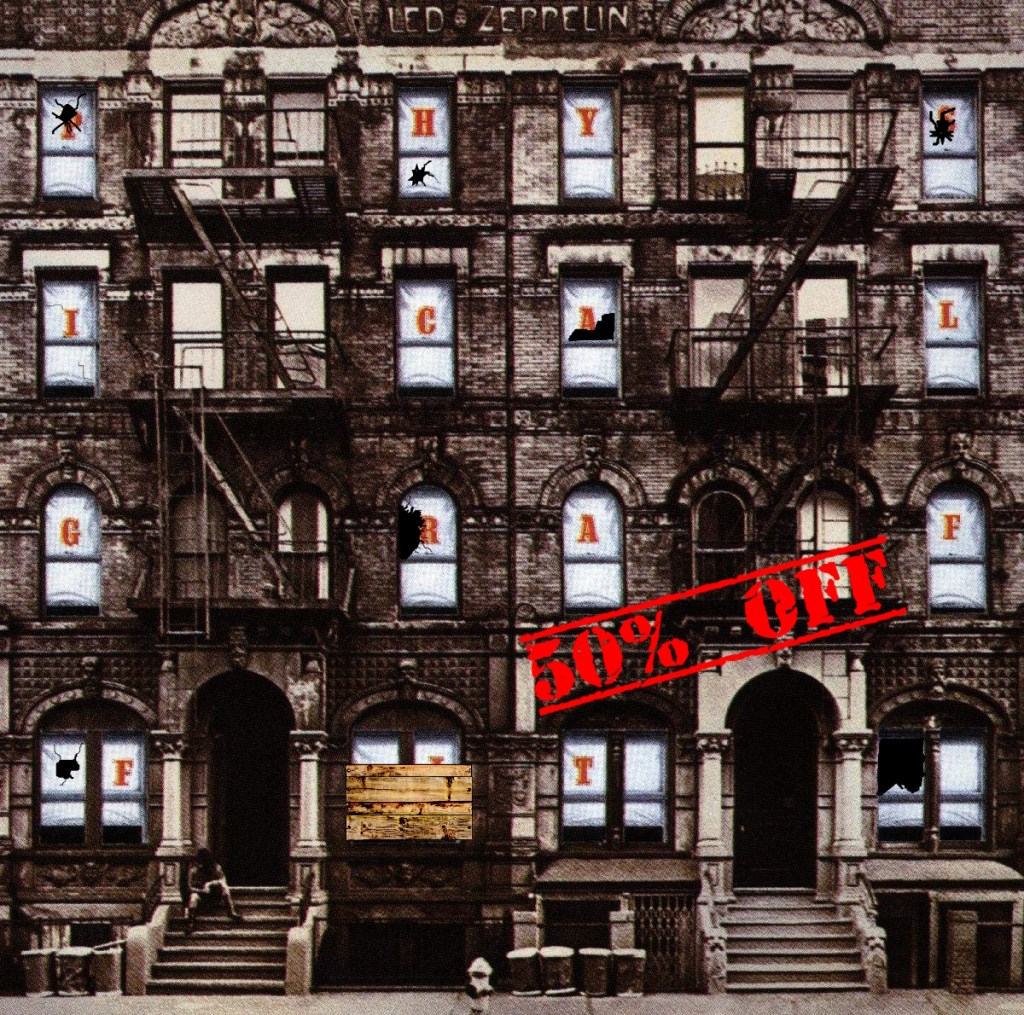
No matter where you may rank Physical Graffitti in your head among the rest of the Zeppelin catalog, one undeniable element that this brought to the table that their other works did not is quantity. The longest Led Zeppelin studio offering prior to (and following) this one was their first one, clocking in at 44 minutes and 45 seconds. Released on the 24th of February in 1975, Physical Graffiti is also notable for its innovative cover design by Peter Corriston, featuring cut-out windows through which you can view various images within the apartment dwellings depending on how you orient the inner sleeves. It made perfect sense to cover an album with such a diverse and expanded assortment of songs in such an interesting package unlike any they ever had before.
It’s a shame I’m about to knock this old building down.
In line with what I did previously with albums by The Beatles and Metallica, I’m seeing what sort of an album I can make of Physical Graffiti if I condensed it into a single record. As a friendly reminder, just because I’m making this reduction doesn’t mean it’s because I believe the album to be a tedious listen. Far from it! I enjoy Physical Grafitti immensely whenever I put one of its two records on my turntable. Take this as a thought exercise that I am, yet again, embarking on. A record label could theoretically nix the idea of a double album or the band could get self-critical and shelve songs they deem to be the most inferior of the lot. Thankfully, Zeppelin released their sixth album as the first of their albums on their own Swan Song record label (Bad Company’s debut would be the label’s first-ever album release), so they’d established the right to put out the music as they saw fit.
Still, could Physical Graffiti have been reduced to one record? Let me give it the old college try.
Physical Graffiti: Single-LP Edition
Side One:
- “The Wanton Song” (4:06)
- “The Rover” (5:36)
- “Bron-Yr-Aur” (2:06)
- “In My Time of Dying” (11:04)
Running Time (Side One): 22:52
Side Two:
- “Ten Years Gone” (6:31)
- “Night Flight” (3:36)
- “Houses of the Holy” (4:01)
- “Kashmir” (8:37)
Running Time (Side Two): 22:45
Total Running Time: 45:37
There were a few very obvious approaches I could have taken here. A thought towards a single album could easily have been to go with the most recent of the material as it was recorded. Those eight tracks recorded between January and February of 1974 at Headley Grange happen to be the most quantitative of the album’s fifteen tracks. Now, eight tracks is very typical of an album, especially for the ‘70s. However, the combined track length of those eight is 53 minutes and 33 seconds. You’d still need to cut out 8 to 10 minutes for it to reasonably squeeze onto one vinyl record. Does axing two-tracks from a single session make for an interesting enough excursion? I didn’t think so. All things considered, I still managed to keep four of them on there, and their combined length makes up for around two-thirds of my cut of the record. I wasn’t aiming for it to be the case, but it’s still very much dominated by their 1974 sessions.
Another approach could have been to simply pick a record. Which do I prefer, Sides One and Two or Sides Three and Four? I know I’d have to have “Kashmir” on it, so the first record would win by default. Once again, not the most fun way to do this. The bottom line is that you could make this into any type of album you want. You could load up on the more folk or ballad-based material, keep it mostly hard and heavy, or keep the most experimental tracks on to make it their straight-up weirdest overall album. I went for a mix of most of these elements, going with at least one track from each of the four sides of the record, across a variety of the sessions, and kept the variety of style that most of their classic, single-record albums contain.
The first question was how to start my cut of the album. Redundancy is the key to reducing a double album to a single, and the lead-off track has to kick things off with a bang. The original track number-one, “Custard Pie”, was a bit too obvious a choice, I thought. The only track from Physical Graffiti that made Rolling Stone’s Top 40 Led Zeppelin Songs list that I didn’t include on my cut, “Trampled Underfoot”, didn’t quite feel like an album starter to me, but wound up being a pretty hard cut. Due to similar run times, it eventually lost out to “The Rover”, so that might make this my most controversial exclusion. Technically on the original four-sider, you’ve got four opening tracks for each grouping of songs, so picking one of these may seem like the logical approach. It wasn’t a deliberate decision, but I avoided doing that. I went with “The Wanton Song”, a track I feel was arguably too far down in the depth of Physical Graffiti. It just has so much explosive energy! The riffing and overall rhythm of this one is more typical of the band compared to some of the previously uncharted territory explored in other compositions, so I think it would ease listeners into the album. “The Wanton Song” was found to be worthy enough to include in Page and Plant’s set for their reunion American tour in 1995, often following its rhythmic cousin “The Immigrant Song”. A right fit for that energetic kickoff portion of a concert (as seen here in a spirited performance in Albuquerque, New Mexico), so a bump up to the top of the order is justifiable.
Why did I end up choosing “The Rover” over “Trampled Under Foot” for the second song? Just a simple preference, not much more to it. The first time that I can recall ever hearing “The Rover” was on Dream Theater’s A Change of Seasons EP, where they covered the tune within a Zeppelin medley that also included “Achilles’ Last Stand” and “The Song Remains The Same”. Still, I believe I heard “Trampled” first (through the fantastic live performance from the 1975 Earls Court show on the Led Zeppelin DVD), so I didn’t have an early bias tilting it in my favour. Its funk-heavy rhythm is certainly strong, but I still find myself tapping my toes to “The Rover” more. It’s got such a great bounce to it, with John Paul Jones and John Bonham throwing down a great groove beneath a great Jimmy Page riff. It was apparently never played in a completed form live, only using the intro to lead into live renditions of “Sick Again”. A pity, if you ask me.
The remainder of my version of the album, you’ll notice, contains three songs that are greater than six minutes long. I wouldn’t been against doing some cheating by doing some hacking and slashing of track lengths if it meant I could fit some more material in. I believe that the vinyl format would ideally be forty-five minutes. Had Zeppelin stuck to a single record and went with the songs of my choosing, they could have opted to do some edits of the extended numbers, saving the live performances to stretch out and give them more wings. Remember, “Dazed and Confused” was 6:27 long originally, and did that thing ever fly for some length on the stage! Or, like the live combining of “The Rover” with “Sick Again”, they could have chose to craft further studio epics by taping the best bits of songs together. I don’t feel any song is overly long, so they are what they are. And Frankensteining a few songs together is too painstaking, so the songs remained…. the…. same.

Much like Led Zep, I’m at the drawing board with Graffiti
Ultimately I thought it too greedy trying to squeeze more and more material on it, but I thought four songs a side makes for a nice balance. “Bron-Yr-Aur” is the biggest beneficiary of the lot due to it’s briefness, but I think it works great as an intro/lead-in to “In My Time of Dying”. Some might say a song that exceeds 11 minutes doesn’t require an intro, but this is one of those cases that running time allowed for this instrumental piece to slide in quite comfortably. And speaking of slide, “In My Time of Dying” is such a great showcase for slide-guitar playing, and the mid-section jams pretty damned hard. It was an easy inclusion on my compilation. Still, it’s worth noting that this is one of those songs in the questionable authorship category. Technically, the true author of the song is not known, pretty much classifiable as a “traditional” song. However, Blind Willie Johnson recorded an early rendition of the gospel song “Jesus Make Up My Dying Bed” in 1927. Bob Dylan also had a notable version titled “In My Time of Dyin’” from his 1962 debut album. Would they resort to covers/homages if reducing an album down to a single record? Sure, why not? It’s in their history to gain significant/blatant inspiration from existing songs (“Whole Lotta Love” and “Dazed and Confused”, to name just a pair). Blues-based rock was seemingly full of it at the time, and this song is such a great showcase for the band, who all shared writing credit on it. And to make things even more complicated, Blind Willie Johnson may have taken significant influence by hearing Reverend J.C. Burnett perform “Jesus Is Going to Make Up Your Dying Bed” in 1926. Wikipedia gives Johnson a credit on “In My Time of Dying”, but my record does not list him. Who IS supposed to get credit here? Was Zeppelin as confused as I am, so left off additional names? Regardless of such a wrinkled history, Zeppelin’s track definitely stands distinct musically, and like the aforementioned “Whole Lotta Love” and “Dazed and Confused”, this doesn’t strip away its standing as one of their classic cuts.
As I did lean heavily into many longer tracks, “In The Light” unfortunately was another victim of my axe. Very much like “Kashmir” in how it feels less like what they had done in previous songs, so it was a matter of not only if I prefer it to that (it never stood a change against “Kashmir”), it was also if I preferred it to the other two extended numbers I selected. One epic too many, though on that thought, trying to edit Tales from Topographic Oceans by Yes down to a single record could be an intriguing carve-job (I’m just as bad as a record exec with these damned slashes!). “In The Light” led off Side Three of Physical Graffiti, and I just so happened to take another song off the third side to lead off my second. “Ten Years Gone” is yet another of the newest block of songs, so while you may think I’m taking too much from those Headley Grange sessions, to this I say “too bad!” I like the idea of beginning with a mellower song on the back-half rather than another head-banger. That does work for albums that lag in the middle, but many will tell you that even the full four sides of Physical Graffiti doesn’t let up. That gives significant freedom in curating the songs that most appeal to me.
“Ten Years Gone” feels like it could have been an older one, the result of which has me occasionally forgetting which of Zeppelin’s albums it’s on, but it always gives me pause when the stylus spins towards the end of Side Three. A double album has deep cuts by nature, and I might say this is my favourite deep cut Zeppelin track altogether. Such a nostalgic song, and not just lyrically, but musically too in its electric-folk flavour. My mind envisions campfires on a cool summer night, sitting on the edge of a dock with a fishing rod, the comfort of putting on a warm sweater, that sort of thing. I could go on, but I’d better cut myself off there before I go into Professor of Rock mode with a nostalgia overload! Robert Plant detailed to Cameron Crowe in a 1975 interview for Rolling Stone (a meeting Crowe had to fight hard for given the band’s distaste for the publication ever since their harsh critique of Zeppelin’s debut album), “Ten Years Gone” was about an ex-lover from long ago:
“A lady I really dearly loved said, ‘Right. It’s me or your fans.’ Not that I had fans, but I said ‘I can’t stop, I’ve got to keep going.’ She’s quite content these days, I imagine. She’s got a washing machine that works by itself and a little sportscar. We wouldn’t have anything to say anymore. I could probably relate to her, but she couldn’t relate to me.”
Relationships and carving out purpose and direction in one’s life are such a universally-relatable topics, so this seemed immovable to me when sung so delicately over such beautiful music.
The middle of my second side could have went in many directions. I knew I wanted at least one more hard rocker, and I think “Houses of the Holy” fit that perfectly as the penultimate song. It always does seem unusual when a band puts a song on an album that shares a title with an album that pre-existed it, but I know that I have a few other albums within my extensive music collection where this is the case, or even cases where portions of old lyrics get recycled in new compositions. Because of this, I didn’t hold it against “Houses of the Holy”, as a good song is a good song.
There was obviously not enough room for everything, and I only had enough space for one more track. The country-flavoured “Down By The Seaside” seems to get significant airplay on my local classic rock channels, so its absence could be glaring to some. I also thought of putting “Black Country Woman” on for some more acoustic content, but thought that “Ten Years Gone” might scratch that itch despite it not being acoustic. “Night Flight” has a bit of a country rock vibe in the chorus that I dig, possibly making up for “Down By The Seaside” being left off. The organ sounds magnificent on this track as well, so I figured having more place for John Paul Jones to stand out as the “quiet” member of the band is a good thing, possibly as an olive branch due to his “Trampled Underfoot” being cut.
While “Night Flight” made the final cut as my last pick, I’d add that “Boogie with Stu” was a contender as it had a comparable running time. “Stu” was another of those tracks calls to question where there is some slight haziness between where Led Zeppelin ends and the primary influence takes over. In this case, the influence came from Ritchie Valens’ “Ooh, My Head”, so credit was given to his mother Mrs. Valens for the purpose of royalties. As Jimmy Page told Musician magazine in July 1988, the band seemed to be charitable here because “We’d heard she’d been ripped off in the past.” It’s got a very sample-able beat to it though, like “When the Levee Breaks”, giving it potential relevance to future generations in that regard. I’m not sure what made the band so selective with who they gave credit to, but of the two songs on Physical Graffiti with the most questionable heritage, one of them was enough.
That leaves “Kashmir”.
“Kashmir” should close a so-called Physically Reconstructed Graffiti. That was practically my mission statement when I made these restructuring attempts, with the song being the ultimate way to captivate listeners and leave them wanting more. Should I even go on about this track, or has it been done to death by so many already? It’s routinely a top 10, or perhaps more so a top 5 Zeppelin song on many lists, including the holder of the number one spot on Mojo magazine’s top 50 Zeppelin songs as well as Vulture.com’s ranking of all 74 of their songs. It’s got a uniqueness among rock songs that many with more musical literacy than myself could likely, and have likely, pointed out. In the It Might Get Loud music documentary film, Jimmy Page accounts for some of this uniqueness in the guitar sound. Page tuned his guitar (from lowest to highest string) in DADGAD tuning, which he took from how sitars are commonly tuned, in what he refers to as the song’s circular riffing. I wouldn’t quite say it sounds a great deal like a sitar in spite of this, but how it plays off the rhythm of the drums is perhaps why I’m not hearing it as Indian-sounding. But that’s integral to the charm, the incorporation of a melting pot or fusion of methods at play, with the string orchestrations and mellotron giving it some otherworldly vibe. Robert Plant stated in a 2021 interview with Dan Rather for AXS TV that ‘Kashmir” was a favourite of his, putting it above “Stairway to Heaven” even, so you could justify that in saying it could anchor just about any Led Zeppelin album and not just Physical Graffiti. His word should be good enough for any, but I figured I’ll share them in the unlikely even that “Kashmir” was set for the cutting room floor of your personal single-record edition of the album.
Seeing as some may think I did this double-album a disservice, I found it only appropriate to do some slight tweaks to the cover. I’m not a skilled enough graphic designer to litter the walls with stylized graffiti, but I did smash a few windows and reduce the price. It’s only fitting, right?
 Armchair Maestro