

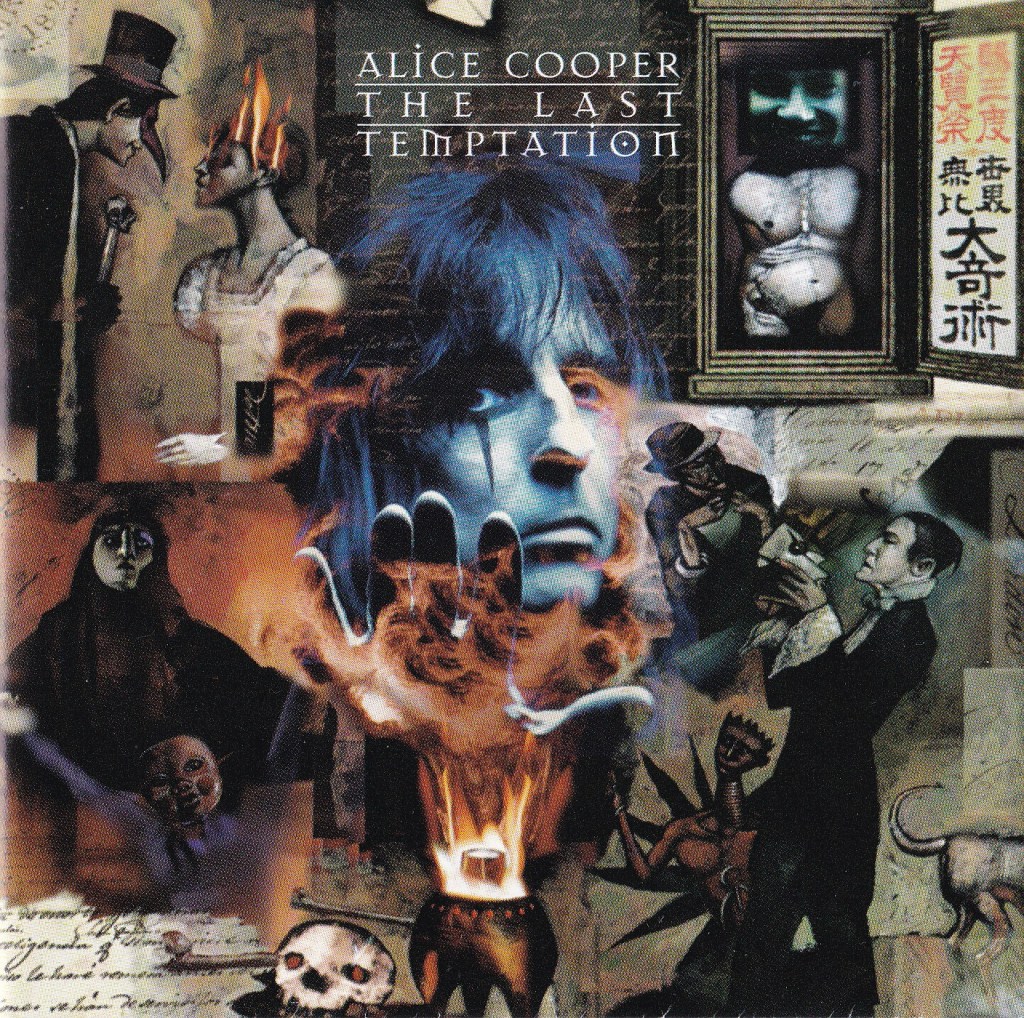
It’s rather common for listeners of rock music to get locked into sticking to the classics. All artists peak commercially, with the duration of that peak varying from artist-to-artist. Alice Cooper has been a memorable pop-culture reference and household name ever since he first broke into the mainstream, but from an album popularity perspective, he had two notable peaks. The first would begin in the early-seventies with The Alice Cooper Group albums and last till around the Welcome To My Nightmare era, after which he’d steadily decline in popularity and presence due to battles with both disco and some personal demons that lasted until later in the ‘80s. The middle of the ’80s through to the early-’90s saw a renaissance in Cooper’s popularity, just in time for him to learn that “We’re not worthy!” of him.
The Last Temptation is arguably just after that second commercial peak period, which began with 1986’s Constrictor and ended with 1991’s Hey Stoopid. I wasn’t particularly looking to add to my Alice Cooper album collection, but then I learned about an album tie-in that I couldn’t refuse. Who can resist the allure of a comic book? Heck, better luck to you in trying to resist three!

My discovery of this comic book miniseries came after learning of two others that had featured Alice. First, I had acquired a Rock ‘N’ Roll Comics issue that served as an unauthorized biography for the shock-rocker. While I haven’t focused specifically on that issue in these pages, I had discussed the entire series in a previous entry. Next, while reading an old issue of the Marvel Comics series of Battlestar Galactica, I spotted an advertisement for an Alice Cooper issue of Marvel Premiere. On my wish list for a few years, I finally found a copy at last year’s Toronto Comicon, and perhaps I’ll discuss it on these pages one day. While looking into that 1979 comic on the moment of discovery, I was reminded that Alice was, in fact, the subject of other comic books that had been released since then. The Last Temptation series stood out as the most prominent of these. Nonetheless, I wanted to get a copy of the album The Last Temptation to go along with these comics, envisioning them as something of a package deal. What greater way is there to take a bite out of lyrics, I figured, than by having some visuals to make the concept come together?
Months passed before my securing of the comics to go along with the second-hand CD that I found with little difficulty, as I figured the best way to get the comics was in a full story inclusive volume. Efforts to obtain each of the three individual parts of the story in comic book form were fruitless, with comic book stores I frequent not having them readily available, and online shopping provided shipping estimates that far exceeded the monetary value of the issues. Eventually, the hardcover edition of The Last Temptation came into my ownership at a fair cost ($15 CAD including shipping) courtesy of Thriftbooks.com.
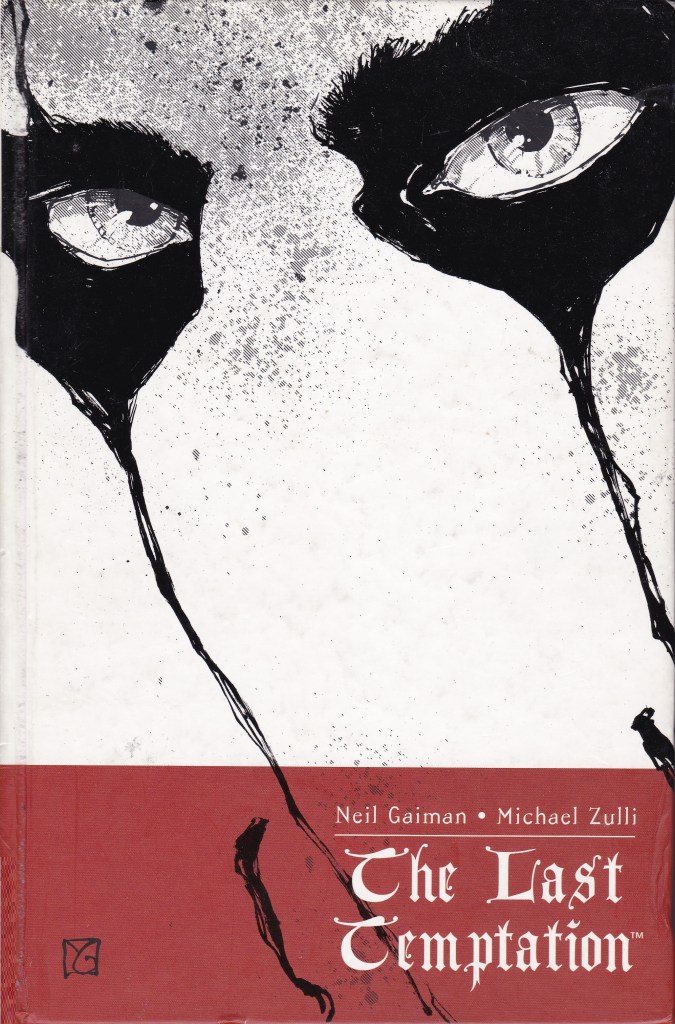
There are some notable differences between the comic books and the hardcover version, particularly the artwork being coloured in the three-issue run versus the black and white drawings within the hardcover. It boils down to personal preference as to what you prefer, but I think the lack of colour adds a bit of a nightmarish vibe to the presentation. It’s not a tone that you can see in your everyday life in real experiences, though I suppose not much in comics is a one-to-one parallel of the world. And of course, there are no advertisements in the hardcover like you would normally see in a comic book. That said, and while I’m not certain that the Marvel-published run contained the standard ads, it wouldn’t have killed me to see the hardcover contain a placement or two promoting Alice Cooper merch. I guess that would be more appropriate of Kiss, another band I’d like to do a comic book focus on one of these days.
For a successful crossover into the comic book world, it’s best to find a like-minded collaborator whose name is as notable as your own. In that regard, Alice couldn’t have done much better with his choice. He didn’t just pick any old writer. On the contrary, he picked a not-so-ordinary young writer in Neil Gaiman, one of those folks in the literary business of such stature that his middle name is often said to be a certain expletive that starts with an F. At this stage in Gaiman’s career (just 33 year old when this project was happening), he had already amassed a significant bibliography. Already established as a writer on various Marvel and DC Comics projects, his The Sandman series is what truly launched him into celebrity status, becoming as recognizable as Stan Lee or Jack Kirby to a new generation. Many key insights to the Cooper/Gaiman pairing can be found in an interview in the introduction portion of the hardcover edition of The Last Temptation. Gaiman developed the overall story with Alice, but it was during a later stage in development that the idea would take the form of a comic. Gaiman also professes to have been an Alice fan prior to getting the call from Epic Records executive Bob Pfeifer about a potential collaboration with the hard rock legend, one that Pfeifer lured to Epic Records back in 1988. As told to Paul Suter in a 1994 issue of HM magazine, Alice credited Gailman for filling the holes in the story line before the songs were completed.
In both the comic and music industries, I’d guess that both physical mediums were near the peak of their grip on consumers at this time. Collector markets had recently emerged for comic books that didn’t exist decades earlier. What was once trash wasting away in the attic was becoming cherished treasures that many nostalgic buyers were looking to get their hands on. Not only were people hungry for Golden and Silver Age comics that they once owned as kids, but many newer lines of comics were also getting snatched up to great notoriety. Most memorable from my childhood as part of the growing wave in comic book interest was the Todd McFarlane series Spawn as well as the X-Men issue #1 from the Jim Lee and Chris Claremont re-launch. The former brought dark, adult-themed comics to a wider audience, and the latter was the best example of the money that can be made in the industry (over eight million sold!). Not that the Alice camp were necessarily wanting to keep the kids away from what they were producing or that they were primarily motivated by money, but the boom of comic books must have held some sway in their decisions. Alice’s uniqueness likely meant he’d never really fade from being a household name, but this seemed like an interesting idea to keep him in the mainstream for a bit longer.
I took a few notes while reading the comic, so my summary is as follows:
—
We start on what appears to be a group of misfit teens, with one of them (Steven) being the primary target of their jokes shared between them. They stumble across an old theatre where a man invites them to watch a show. All of them have excuses except Steven, and they egg him on to try it out, as the theatre’s host (who looks strikingly like Alice Cooper) has proclaimed that only one of them may enter. The two other boys depart, and Alice shows Steven around.
We are introduced to a lady named Mercy, who rips his ticket as he enters. The ticket was seemingly complimentary, as the phrase “everything here’s free” gets repeated numerous times. Steven sits down in what appears to be an empty theatre, and Alice introduces the show. This place gets referred to as “the theatre of the real”, with our host stating that this is a show that sheds truth on society.
As the play starts, Steven gets injected into the story, meeting gross, decaying people on the streets. They are known as “blood brothers”, and Steven faces the choice of becoming one of them or staying in the safety of the theatre where he could stay youthful forever. Steven eventually attempts to leave, but learns he cannot do so until the play is over. This twisted show proceeds with a seductive dance by Mercy before the show ends abruptly and mysteriously. The host makes mention of an eventual grand finale, but for now, Steven must leave.
Without giving too much away, we go on to see how that unearthly theatre experience impacts Steven. He has visions and nightmares as the events and characters from what is now an apparently vanished theatre creep into his life. We get a hard time discerning whether the show presented Steven reflected how the world really is or if there’s some sort of devilish entity corrupting him. The temptations continue with promises to make Steven a star. To get to the bottom of what is happening with him, he begins researching the theatre in the hopes of finding answers.
—
My notes are hardly a substitute for taking this in with your own eyes (and ears in the case of the album), so let’s hear straight from the horse’s mouth. If certain story elements sound familiar to you, Alice cites Something Wicked This Way Comes as an influence on the concept in this MusicRadar.com retrospective, as well as the biblical tale of Jesus being tempted by Satan. The album’s press release also served as a tantalizingly-constructed preview, containing a succinct summary in addition to questioning if “we’re in dire need of a new messenger with the communicative power to lead us from the depths of doubt and dark despair”, which can be taken as a duality of Alice himself and the theatre host character “The Showman” in his and Gaiman’s tale.
Let’s get into the visuals. If you are like me and obtained the CD first, the folded liner notes contained a teaser to the comic book. I don’t own the colorized comics, so this served as my main frame of reference for how they appeared.
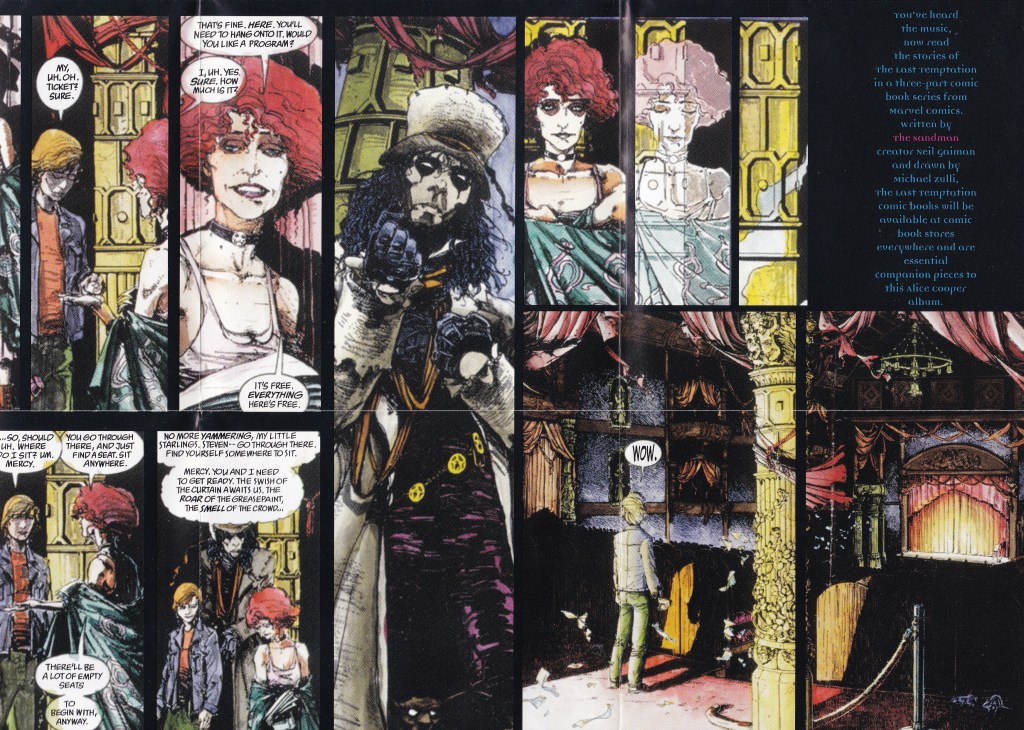
The drawings in the comic, as teased above, were handled by Michael Zulli. He worked with Gaiman in the past on a Sweeney Todd story, as well as some of the Sandman issues. Another notable work of his that pre-dates The Last Temptation is an arc within the Mirage Comics Teenage Mutant Ninja Turtles series dubbed the “Souls Trilogy”. Zulli unfortunately just passed away on July 8th of this year. Todd Klein did the lettering, who also worked on Sandman along with a wide range of projects within DC Comics and was a freelancer, going on to win several Eisner and Harvey Awards for his work. The common link between these artists really gives a sense of unity to Alice’s story, and no doubt helped to bring the project along in a timely manner. It just makes too much sense to stick with a team that had established themselves so successfully.
Interestingly enough, they didn’t go with Zulli on the comic’s or the album’s cover. I suppose you get that sort of division of labour in the comic industry quite often, where a different illustrator handles the covers much of the time, so perhaps I shouldn’t have been too surprised. I should have known better as yet another key player in the Sandman team was involved. The covers on the original three-part comic series were done by the same artist that did the album cover for The Last Temptation, Dave McKean. McKean, at this stage in his career, had done the covers for Paradise Lost’s Shades of God, Tori Amos’ “God” single, and would go on to do art for the likes of Testament, Front Line Assembly, and Earthworks among others. Of note, McKean is also a musician, and would later collaborate musically with Gaiman on BBC Radio performances of stories such as Signal to Noise. In terms of the album’s visuals, alongside the cover art of McKean’s, other art direction on The Last Temptation is credited to Aimee Macauley. She has contributed her design expertise to albums including Illmatic by Nas and Evil Empire by Rage Against the Machine. The first of the three issues of the comic (released by Marvel) also had an alternate cover, which matched that of the album’s cover, an important note for the completists in the crowd. My hardcover edition (by Dark Horse Books) appears to be Zulli’s work, a close-up of Alice’s trademark blackened eyes.
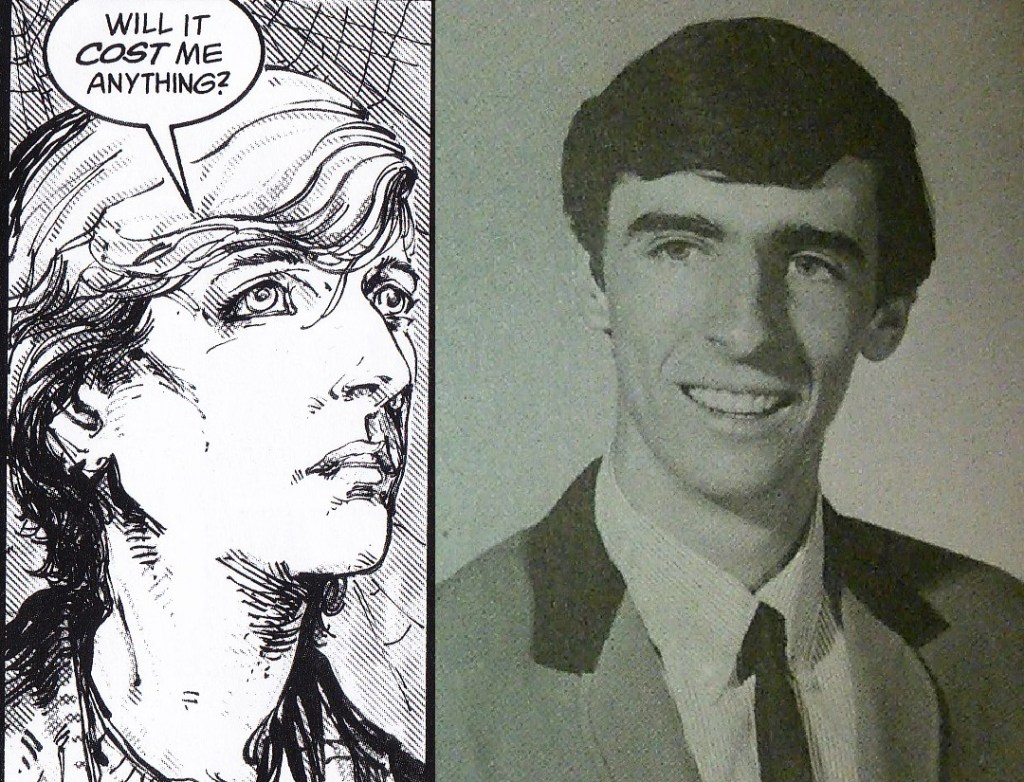
I encourage you to seek out a copy of the visual telling of the story in either format, so I’ll only share a few more teaser images. First off, I’ve got to say that likeness of the Steven character to young Alice Cooper (back when he went by his birth name of Vince Furnier) stands out to me. I’d have to think it was intentional, but compare below for yourself.
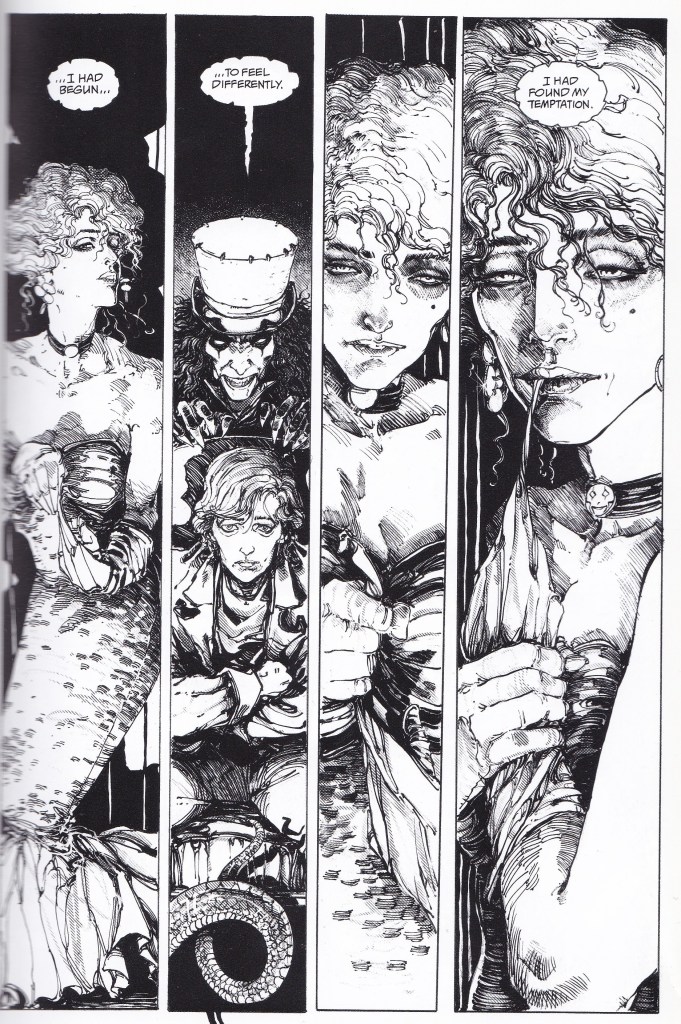
Below, you can see Mercy’s portion of the tempting performance. I’d say the red hair previously shown on her from the liner note preview doesn’t work as well as the black and white. Her facial expressions are very tortured, even more so than Steven’s.
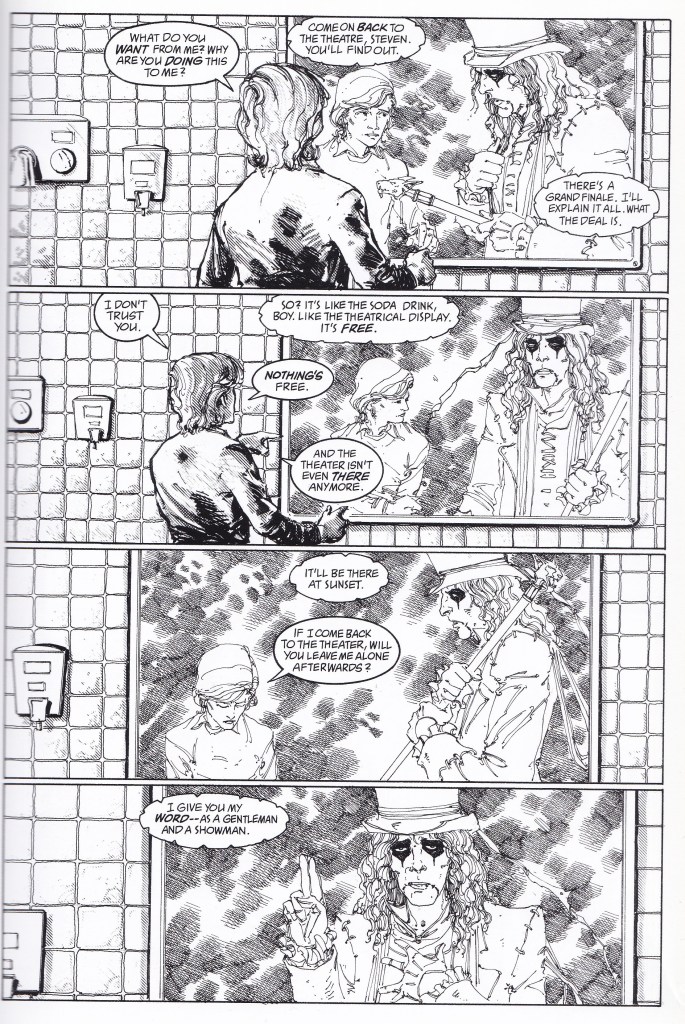
Here are some shots of Steven in the real world, just as the Showman pulls the reluctant teen back towards the theatre. Would you trust a man in the mirror to keep his word? Frankly, I don’t even know if I could trust my own thoughts if I started seeing Alice Cooper in public washrooms. Not only that, such a sight would probably make me forget to wash my hands!
This discussion was supposed to be about an album, wasn’t it? Time to talk music, I suppose…
Alice Cooper’s band is known for having rotating positions, so who backed him on his thirteenth solo studio album? We’ve got Stef Burns on guitar, whom Alice was quoted as calling “the most consistent guitar player I ever have had” in a November 1994 issue of Guitar (aka Guitar for the Practicing Musician). Previously a member of Y&T, Burns has several dozen session credits to his name that includes multiple recordings with Vasco Rossi, has been a member of Huey Lewis and the News since 2001, and was part of Sheila E’s band in the ’80s. Greg Smith, the bassist on the album, has performed with many noteworthy names in the business, including Wendy O. Williams, Richie Blackmore’s Rainbow, Ted Nugent, and Joe Lynn Turner. On drums is David Uosikkinen, who played in the band The Hooters prior to and following his time with Alice, but has also performed with the likes of Cyndi Lauper and Smash Palace. Lastly is keyboardist Derek Sherinian, an in-demand gigging musician that was best at the time best known for working with Kiss, and later with Dream Theater, Planet X, Black Country Communion, Sons of Apollo, and other projects in the progressive rock and metal realm. The nickname “the Caligula of Keyboards” was once bestowed upon him by Alice. That is one heck of a thing to be called, the meaning behind which (as told to SeaOfTranquility.org) Sherinian has no clue about other than something that makes for a good sound-byte. Burns, Smith, and Sherinian also provide background vocals, as do Lou Merlino, Mark Hudson, Brett Hudson, and Craig Copeland.
The range of collaborators on this one continues the path of Hey Stoopid, but mostly in the songwriting department. Alice has always been open to collaboration, having written on past albums with such notables as Nikki Sixx and Mick Mars (of Motley Crüe), Bernie Taupin (Elton John lyricist), and Jon Bon Jovi and Richie Sambora (Bon Jovi). In fact, the album Taupin helped co-write (From the Inside) was the one for which the Marvel Premiere comic was based on.
Tommy Shaw (Styx) and Jack Blades (Night Ranger), who previously paired with another rock legend in Ted Nugent for their Damn Yankees “super-group”, helped pen two of the album’s ten tracks. Jim Vallance returns to the fold, having co-wrote two songs on the previous album (“Die For You” and “Dirty Dreams”), this time only contributing once. Soundgarden’s Chris Cornell, with his two-song contribution, may be surprising to some. You might not think Alice would have been welcome to working along with one of the grunge guys, since he once admitted (the exact quote I can’t find) there was a point where he wanted to round up all the Seattle bands and take them to Disney World since they seemed so unhappy. Yet here he is, assisting in the writing of a further two songs. Mark Hudson (Aerosmith), and Steve Dudas (Ozzy Osbourne) also come with notable song writing careers. Bob Pfeifer, being a record label man, may seem like another odd songwriting partner, having his name on four of the album’s ten tracks. However, he served prior time in a band of his own (The Human Switchboard) and released a solo album titled After Words in 1987, so perhaps his musician background was what endeared him to Alice in the first place. He also co-wrote seven of the twelve songs on Hey Stoopid. Dan Wexler of Icon, a Phoenix-based outfit (where Alice had also relocated), contributed some songs. This looks to be a case of Wexler returning a favour to Alice, as Cooper previously guested on Icon’s Right Between The Eyes album on the tracks “Two For The Road” and “Holy Man’s War”. Other writing contributors included Brian Smith, Michael Brooks, Jon Norwood, and Bud Saylor.
I’d describe The Last Temptation as very much an of its time (late-’80s to early-’90s) polished-sounding production, which is spread between Andy Wallace, Don Fleming, and the duo of Duane Baron and John Purdell, all of whom split the songs relatively evenly between them. The continuity in sound is quite impressive here, as employing four producers on a single album isn’t very common in rock circles. If I didn’t know otherwise, I would have assumed this wasn’t done by committee.
A quick overview of the ten songs that provide the music end of The Last Temptation:
“Sideshow” begins with an acoustic intro, but soon storms right into a riff that could have been straight off one of his ‘70s record. A surprising amount of horns for a Cooper song, but the song builds well. I can hear this one dressed up a bit differently and it could fit a few eras of Cooper’s, very much how a conceptual Cooper song should feel. I find a lyric like “I want a scary ride, see Jekyll turn to Hyde” seems a bit more bold than how the more-introverted character in the comic behaves (if taken from his perspective), but is very on-brand for Alice.
Thundering drums kick off “Nothing’s Free”, and Alice goes into a deeper, more monotone Iggy Pop-like vocal (at least to my ears, possibly a Michigan way of emoting?) in the verse. Here is where the lyrics hint at the illusions of the real world, and talk of striking a beneficial deal, but “nothing is free”. The story-telling is doing more of the heavy lifting than the music on this one, but it’s got a great guitar solo and overall lead guitar playing.
“Lost In America” was a single, and had an accompanying music video that briefly shows images from the comic (which can be watched here). The lyrics sound teenage-minded in their repetitiveness and structure, which matches the very punk-rock style of the song. A theme of looking for parental figures rings through in the second verse, with Steven feeling he’s not getting enough guidance, thus can fall prey to temptation. The off-kilter “Star-Spangled Banner” outro is a nice touch!

“Bad Place Alone” returns to the more darkened Broadway-feel of the album opener. It swings pretty good, particularly with its “hey, blood brother” refrain. An exploration of some of the dark realism in certain portions of society, with focus on a character called Smoky Joe who is living a pretty hard life with his addictions (“I shake like a cold chihuahua”).
The de-facto title-track “You’re My Temptation” has that almost strip-club swagger with that laid-back eighth-note pulse of the guitars and bass. It hooked me on my first exploration of the album, and is still one of my favourite pieces here. I would have picked this to be the single if it were up to me, but I’d add that it may be one of the more 80’s-feeling songs on the album. Maybe they felt “Lost in America” fit better in the current music scene, who knows? I’m not surprised that this one was a Baron/Purdell production, as the way the backing vocals reinforce the powerful chorus reminds me of what they did for Ozzy on No More Tears.
“Stolen Prayer”, as a means to pair Cooper with Cornell, is one that worked stunningly well. Alice’s vocal style is hard to describe, but there are few who would rank him as a singer above Cornell, but their contrast in styles sounds great in their trading of lines in the chorus. You could classify this as a power ballad, or is at least the first hint of one on the album. Cornell’s demo of the song was compiled on the unofficial release Stolen Prayers, on which it is noted as one of the “Songs for Ozzy” along with “Heartfist” and track that follows on this album. It’s interesting to note the song’s transformation, as they did a great job with pulling it more into Cooper’s style. On a related note, Alice had a great fondness for Chris that was reflected upon the news of his suicide. He noted “I’d never seen anybody that had the package as much as he did”, and from a vocal perspective, Cornell showcases some of that here as he hits a higher register in the last of the song’s choruses.
“Unholy War” was another Cornell track, and was the first song released from the album (no music video though). This one I think has more of that Soundgarden vibe, which perhaps makes this one a bit less suitable for Alice. With Cornell’s vocal, it probably could have fit fine somewhere on Superunknown or Down On The Upside. Does this mean it takes a conceptual detour from the remaining songs? Possibly. Listening to the demo, the lyrics only appear to have minor tweaks to them. Musically, I think the increase in tempo was the right choice, and it fits in well into the mix.
Do I hear a “Lucy in the Sky with Diamonds” influence on “Lullaby”? I’m sure plenty of parents sing Beatles songs to their kids when tucking them into bed, but that’s beside the point. I love the snarl of the chorus on this one, with lines like “I smell your sulphurous smell” showing that Steven has had just about enough of what had been presented to him. The contrast between sections is pretty powerful as the repetition of them twists them together into a song that becomes one of the heavier tracks of the lot in spite of the deceptive title.
“It’s Me” has a similarly whimsical feel to the preceding track, and also touches on that power ballad territory with more accessibility than “Stolen Prayer”. I should have guessed this was another Shaw and Blades co-write, with its eye seemingly on the mainstream. I suppose the existence of a music video for this one answers my question as to why “You’re My Temptation” never got a video, possibly out of fairness to his other collaborators. Another prominent use of extra instrumentation (do I hear cello and mandolin?), though I’d almost argue this one is a bit too dressed up.
The initial portion of “Cleansed By Fire” gives off Savatage vibes, but of course their theatrical writing was surely partially derived from classic Cooper. I quite enjoy the transition to the “You offered me the world an all its wealth” passage, with the backing vocal to Cooper’s (along with the increasing heaviness) contributing to an eerie atmosphere. I first thought that the chorus felt a little cliche, but love the effect of layering “What about..” lines over top of it to give the track redemption and breath new life into it. How wrong of me to question how he builds an album closer after his vast album-making experience! A fine album-ender, indeed, as Steven closes this bizarre chapter of his life.
If I were to take the lyrics separately and juxtapose them with Zulli’s drawings, can I get the same impact? It’s likely possible, but that may not be the desired takeaway from this collaboration. While the story’s concept was a shared Cooper/Gaiman creation, Gaiman received no lyric credit, and Alice shared no credit in the comic’s story. You can view this as their own interpretations of the same idea, as both are artists and want their own identities to shine through.
The Last Temptation was released on the 12th of July in 1994, meaning it just celebrated its 30th anniversary days ago. The album peaked at number 68 on the Billboard 200 and remained in the charts for just three weeks. In comparison, Hey Stoopid reached number 47 on a 13-week stay, and Trash hit number 20 in a fruitful 43-week appearance on the chart. While this is nowhere near the commercial and personal lows dating to around the point of DaDa, an album that not only failed to chart but one that Alice has little memory of even making, but I’m sure the album’s performance must have been considered a disappointment. Still, we know that these sales and popularity metrics do not tell anywhere near the true quality of music on any particular album. With what Alice had in mind for this album, there was always an element of risk attached in trusting that a wider audience being able to buy into a concept despite some of his biggest albums having used them.
And speaking of risk, no touring was ever done to support this album. That seems almost unheard of for the time! A detailed breakdown of the time frame surrounding the album provided by the website SickThingsUK gives an idea of his whereabouts. From the point that he began writing the album and story with Neil Gaiman in 1993 up to the end of the album cycle in 1995, Alice played only a series of concerts and festivals in South America between the 2nd and 9th of September of ‘95. Perusing the provided setlist from the Sao Paulo show, four songs from The Last Temptation were performed (“Sideshow”, “Lost In America”, “It’s Me”, and “Cleansed By Fire”). The tracks provide a decent sampling of the album, but I can’t help but wonder if it would ever be performed in its entirety. Assuming that an unlikely task so he can squeeze in the fan favourites, maybe a few others would have at least been rotated into the set. It’s a shame that only such a limited portion of the world got to see him at this time.
Instead, more emphasis was put on making promotional stops and granting interviews. Alice has always been a pleasant part of pop-culture going back to the ‘70s when he made friendly with the Muppets, and it would not be much different in the mid-‘90s. A strong sampling of such globetrotting appears scattered throughout YouTube, including travels to Sweden (taking fan calls with Gaiman), ones in the United Kingdom (where he speaks of the real world influence that gun violence and crime had on the story), and a stop in Australia (where the titular host of Denton reunited Alice with his “first lover”). Typical stops you’d expect him to make on a world tour, only he talked for the music rather than let his music do the talking. Still, fans must have been aching to see the full show on a stage near them. Record label support may have played a factor in cutting tour plans short when you consider that Cooper would eventually leave Epic Records for Hollywood Records, a label that Bob Pfeifer was named president of in March of 1995.
From what I’ve read, since I have no first-hand recollection of the album’s release when I was nine years old, reviews seem to have been mixed. John McDermott called the album in his Guitar magazine September 1994 review “a valiant effort that Cooper fans no doubt will enjoy”, with focus on “Side Show”(sic) in particular as “a welcome throwback to Alice’s ecstatic early 1970’s efforts”. On the other hand, a Flux magazine review from the same month called it “lackluster” and “for Cooper diehards only” (to take some of the kinder portions from Gary Cee’s 3/10 appraisal). Rolling Stone split the positive/negative difference with a three out of five-star review, though reviewer Chuck Eddy stated that after the first two songs that “Alice gets a bit too melodramatic – just like his old music did, not long after ‘I’m Eighteen’ and ‘School’s Out’”.
Well, I am an Alice Cooper fan (even that cursed melodramatic stuff!), so the appeal is something that I can definitely relate to. Would this be the best place to start in his discography? I don’t think I would start on this one, but I would point it out as a fine example of a case where enjoyable material still exists beyond Alice’s so-called “classic” era. Not to be confused for one of his finest albums, more so an intriguing one in a rather intriguing time in Alice Cooper’s career. In all, I’d say don’t skip this one. You’ll have fun, particularly if you dive deep into it like I did.
 Armchair Maestro
One thought on “Deep In The Discography: The Last Temptation by Alice Cooper”