

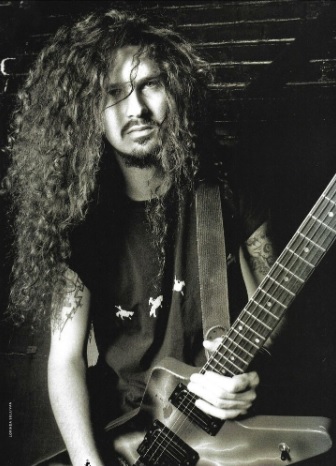
December 8, 2004.
It’s twenty years to the day since Darrell Abbott was senselessly murdered in front of an adoring crowd at the Alrosa Villa in Columbus, Ohio while performing with Damageplan. I won’t go over the harrowing details of that night nor will I name the perpetrator, as that information can be found elsewhere. There are far more important names to mention that were at the venue that night, those that were just there for a good time whose lives ended far too prematurely: concert-goer Nathan Bray, venue employee Erin Halk, and Damageplan security chief Jeffrey “Mayhem” Thompson. Three others were injured: Damageplan’s tour manager Chris Paluska, the band’s drum tech John “Kat” Brooks, and Travis Burnett (crew member of opening act Volume Dealer). Officer James Niggemayer fatally subdued the perpetrator, but each of these individuals heroically either stepped in efforts to save the victims or restrain the culprit once it was known that Darrell was in grave danger. While I (and surely many of you) find the precise details difficult to look at, I cannot imagine what their loved ones went through in the aftermath, and my heart continues to go out to all that lost someone close to them in the shooting.
If the 8th of December sound significant to you aside from this, that’s likely due to the fact that John Lennon was murdered on that date twenty-four years prior. A large number of North Americans heard the news of the death of the former Beatle, from all sources, in an NFL broadcast when Howard Cosell (who had become friendly with Lennon during a previous in-game interview segment) made an announcement in the closing seconds of a New England Patriots / Miami Dolphins game. In the internet age, I’m certain that word of Darrell’s passing hit people through a greater variety of channels than John Lennon’s. Darrell Abbott, known as “Diamond Darrell” when he broke onto the music scene, though became better known later on as “Dimebag Darrell” or simply “Dime”, may not have had the global fame of John Lennon, but among the hard rock and metal community this loss hit just as hard.
There are certain world-shaking events that those who were alive at the time of can remember exactly what they were doing when the news broke, such as the moment the World Trade Center was struck on 9/11 or the 7/7 terrorist attacks in London, England, and going back to previous generations with the attack on Pearl Harbour or the nuclear strike on Hiroshima, incidents that directly impacted hundreds and thousands of lives.
The tragic deaths of celebrities, while the direct number of casualties or death counts are typically on a much smaller scale, can still radiate the world over. John F. Kennedy’s assassination would be the most-commonly referenced example, understandably so as he was president of one of the most powerful nations in the world. Princess Diana’s death had a similar global impact as JFK’s despite not being the head of state. My strongest memory of that would be that it was close to the day that Mother Teresa died. So-called “gangsta rap” made headlines for a good chunk of the ‘90s, likely making it my earliest exposure of sudden deaths in the music world. I wasn’t largely exposed to a great deal of hip-hop at the time, but remember Notorious B.I.G.’s shooting being quite impactful and much buzz about it in the schoolyard. Of course, the Tupac Shakur murder preceded this. While part of an earlier wave of rap, I recall Jam-Master Jay’s murder in 2002 (which just resulted in guilty convictions this past February) making waves. I always enjoyed hearing Run DMC, but they weren’t a band I was actively listening to despite having a strong familiarity with their big songs.
No corner of the music world is immune to these tragedies. As I got into jazz music in my twenties, I would learn of the death of Lee Morgan, shot by his girlfriend while performing on-stage. Soul singer Marvin Gaye was also shot by someone he knew well, his own father. Peter Tosh, a former member of Bob Marley’s backing band the Wailers and a successful solo reggae artist in his own right, was murdered in a home invasion. I’m surely leaving out several, but that already paints a depressing enough picture. Conflict that is not resolved in a healthy manner, mental health issues that haven’t been properly diagnosed or treated, random acts of violence, so many possible reasons that many of the above transpired. Regardless of what the root cause of any of these losses were, many fans, friends, and family will struggle to come to terms with the outcome for the rest of their lives.
Despite the headlines that all the aforementioned cases made, speaking of the ones that took place during my lifetime, I only have vague memories from when the news hit me. Dime’s was the first musician death that felt like a punch in the gut when I learned of it the morning after. It began at the start of typical day right before I headed to the college campus for a final exam. Part of my morning routine then was turning on the satellite radio stations that DirecTV had to offer, usually settling on the “Metal” channel. One song I can definitely remember hearing was “Shattered” by Pantera. It was then followed by another Pantera song. And then another. I didn’t think much of it other than it being a possible sequencing error in their playlist. I left home to catch the bus, and put it out of my mind.
By the time I got to the campus, I still had a bit of time to kill before the exam. While in the computer lab where we were to write the test (it was an Excel spreadsheet-based course), I went to my go-to website: Megadeth.com. Back in the day when internet chat forums were a predominant form of social media (Myspace being another relic of note), I found some fun in chatting with others on the Megadeth forums.
It was there that I learned the terrible news.
Using Web Archive’s WayBackMachine, I was recently able to find the banner that Megadeth posted on their site in the aftermath of Dime’s death.
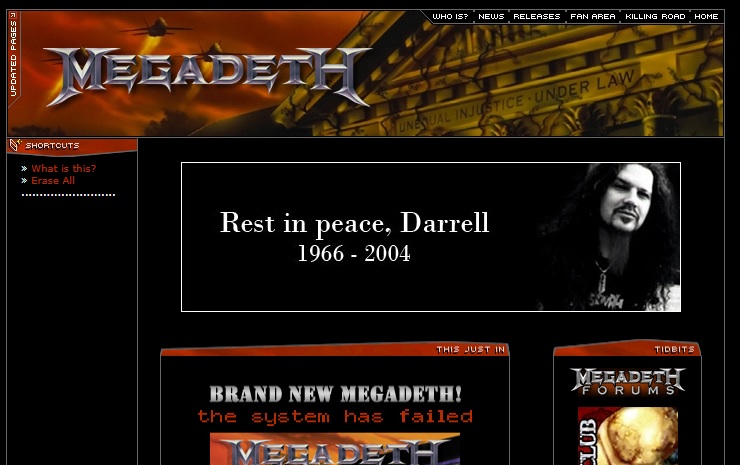
I believe that an additional splash screen dedicated to him would display prior to redirecting the visitor to the Megadeth homepage for at least a couple of days following his death, but I cannot locate it. It just so happened that the Megadeth linkage to Dime had some significance. Not only had Megadeth and Pantera shared the stage in past tours, a favourite alcoholic beverage of Dime’s that was known as a Black Tooth Grin was named after a lyric in Megadeth’s song “Sweating Bullets”. Going back further, Darrell was once offered the second guitarist role in Megadeth, but he declined it to remain in Pantera out of loyalty to his brother (drummer “Vinnie Paul” Abbott). Soon after Dime’s tragic end, Megadeth (band main-man Dave Mustaine in particular) would enter the picture again. A frequent presence on MTV, perhaps most notably his work with Rock the Vote during the 1992 US Presidential Election cycle, Mustaine hosted a special episode of Headbanger’s Ball that honoured the beloved guitarist. On top of its inclusion of comments and calls from a few different musicians, I thought that Dave also took calls from fans during this show to let them grieve, but that may be when my memory is failing me.
This was the only time during what I refer to as my college/university years (spent non-consecutively between 2003 and 2010) that I can recall precisely where I was and what I was doing when I learned of a noteworthy death. I recall Michael Jackson dying during this time, but not being terribly shocked due to various rumours that were already out there about his health and well-being. I also learned of comedian George Carlin’s death either as we were travelling to our university residence or around the time we arrived, but I can’t pinpoint it with certainty. I mean, there is a crazy amount of details I can remember from December 9th of 2004. For instance, a bonus question from that day’s exam was a multiple choice regarding what comedian Larry the Cable Guy’s catchphrase was. I had never heard of Larry the Cable Guy until that day. Just a small way in which life was better for me back then, I suppose.
This may seem inconsequential to anyone else, but here’s a minor detail about Dime’s last show that caught me by surprise: the Alrosa Villa had a capacity of just 600 attendees. Learning they’d play a venue that size was akin to telling me that they had a gig at the local Royal Canadian Legion hall. In my world, these guys were HUGE. Name the magazine targeting metal fans or guitarists, and it seemed Darrell was on the cover of at least one such publication in any given month. That’s some of the naivety I had at the time, assuming Damageplan were selling out hockey arenas rather than getting middling attendance at some smaller concert venues. Locally to me in Toronto, they had gigs on their itinerary at The Opera House on June 17th of 2004 and the Phoenix Concert Theatre on December 1st when I would have expected them to be booked at Air Canada Centre. I’ll chalk that up to the level of idolization a teenager can have for a musician that elevates a person, plus the only small venues I’d seen shows at were in my hometown rather than Toronto.
It’s after twenty years that I can certainly say that he went too young. Of course, even then I knew he died before he should have considering that he was much younger than my parents were at the time, but he was also nineteen years older than me. I couldn’t even fathom where I would be in life by the time I was thirty-eight years old. Married? Children? Twice-divorced? Some world tours of my very own? That nineteen years seemed a relative eternity, but I still feel like I’m on the younger side of things now that I’ve surpassed the aged that Darrell reached. It’s scary to think about how fragile life can be, and we all know someone that didn’t even make it to thirty-eight. It can really live in your head if you let it.
—
Anyway, I think I’ve spoken enough about the death aspect of Dime and my personal experience with it, so now I want to turn the attention to his legacy.
For the bulk of people out there, Pantera’s five studio albums from their Atlantic Records years are his legacy.
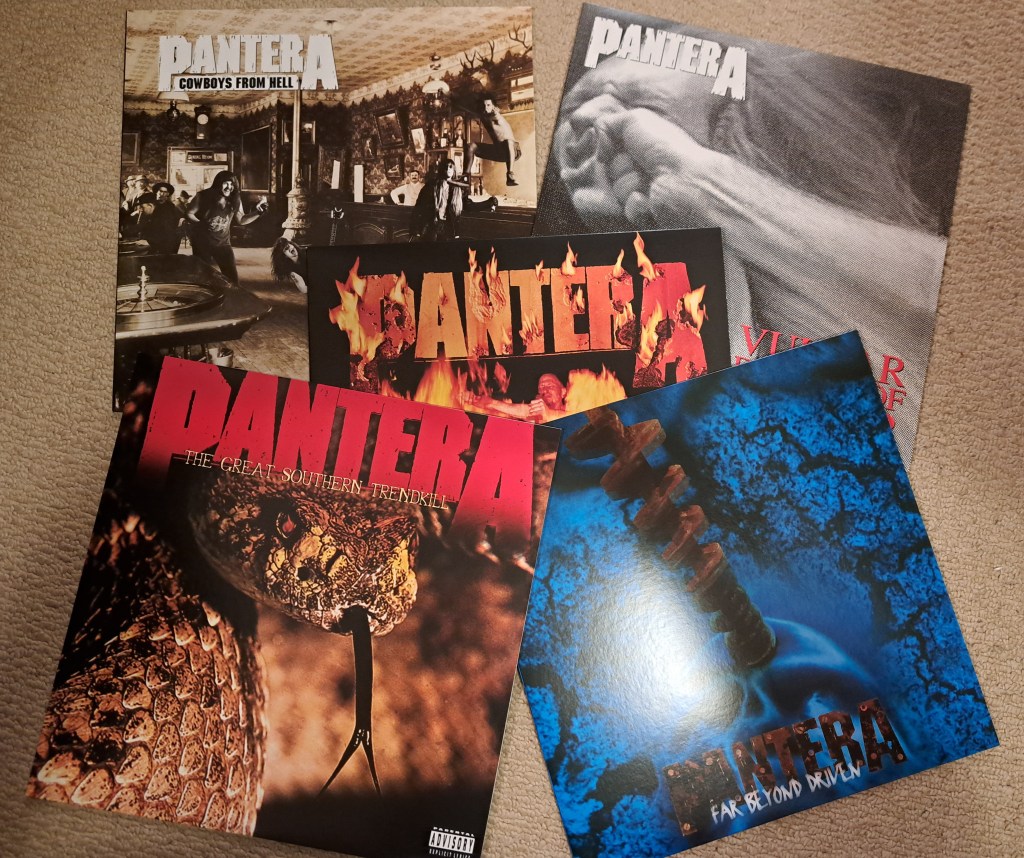
I often wonder why Pantera’s first four independent albums (Metal Magic, Projects in the Jungle, I Am the Night, and Power Metal) haven’t been given a better treatment. Sure, people who have heard the music can appreciate it for what it is, but how about re-issuing the stuff to get more ears on it? Most times I see any of the albums on sale, they are bootlegs. If they weren’t, they wouldn’t be nearly as affordable. I don’t particularly like buying bootlegs if I can help it, so some official means of purchase would be preferable. For what they are, they are enjoyable listens, especially keeping in mind that Dime was just 16 by the time that Metal Magic was released. He got all the flash and showmanship out of his system early on by winning guitar contests, and here he was figuring out how to craft some songs. I think they are important to hear in terms of understanding how a band can develop. With the help of their father Jerry Abbott, Darrell and Vinnie (along with bassist Rex Brown and vocalist Terry Glaze) got valuable recording experience earlier than many bands would have in those days. Sure, it might sound more redundant in the context of the era than what they eventually became, but what teen-aged bands have their own sound right out of the garage? I’ll say the band (more likely their management) are partly to blame. To this day, their discography begins at Cowboys from Hell on their website, but at least the living members of the band have come around to acknowledging the old albums. Examples of this include Phil Anselmo incorporating Power Metal into his ranking of the Pantera albums through an interview with Revolver in 2021, and Rex Brown expressed some fondness for their early material in his long-form interview with Gibson Guitars for their Icons video series.
The dedication factor alone should not just be part of Darrell’s legacy, but for Pantera as a whole. How long can a band take toiling in the club-level circuit without the payoff of a halfway-decent record deal? Pantera did so for nearly a decade. They could have packed it in, taken up another line of work, or even relocated to another area of the country to garner more attention, but they didn’t. So many quit before that point, and understandably so in a difficult business, but they stuck to their guns in Texas. The Pantera story could have went down in an even more obscure existence than The Story of Anvil, but they found their audience eventually. Good on them for believing in themselves, and eventually finding their musical identity.
Dime and John Lennon do share at least one other thing in common, they both have a sizable body of work that they left behind in their shortened time with us. The difference is that while Darrell broke through in a time where bands weren’t making a habit of cranking out an album any more frequently than every two or so years, he more than made up for it by being a road warrior. With Pantera, he played at least 750 shows going back to around 1986 when vocalist Phil Anselmo joined the band, at least according to the list provided on Pantera’s official website. With Damageplan, they played 112 gigs in 2004 if we go with the tally on Setlist.fm and TourDateSearch.com, which factors in their final show, at which the band was only able to play a portion of “Breathing New Life”. I’m sure that total was past 1000 shows if I could find more information about Pantera’s earliest shows. You want a legacy? How many of those concert attendees saw Darrell and were convinced to take up the guitar, or go further and start a band? Not an insignificant amount, I’d wager.
“What if..” thoughts exist for me with Dime like they exist for many others musicians that left before their time, as I can’t help but think what the contributions of many others in metal would have been with more time. Cliff Burton only got to make three albums with Metallica, and Roger Patterson (who, like Burton, was a highly-skilled metal bassist that died as a result of a vehicular accident) only got one finished with Atheist, albeit with significant demoing of a second. Then there’s one of Darrell’s biggest influences, Randy Rhoads, best known as guitarist in Ozzy Osbourne’s band in the early-’80s. Of his four studio albums that were released in his lifetime, two of them (the first two Quiet Riot albums) were only released in Japan. Fortunately, Dime’s output did spread beyond what were his two primary bands.
Most memorable of Darrell’s extra-curricular activities in music to me were his guest spots with Anthrax. Once the thrash band parted ways with lead guitarist Dan Spitz, they often used the guitar solo sections of their songs as an opportunity for guests to come in and lay down some leads. Darrell contributed six solos across three studio albums, Stomp 442 (“King Size”, “Riding Shotgun”), Volume 8: The Threat Is Real (“Inside Out” and “Born Again Idiot”), and We’ve Come For You All (“Strap It On”, “Cadillac Rock Box”). No disrespect intended at all to the likes of Paul Crook, Mike Tempesta, Charlie Benante, and Rob Caggiano, all of whom put down some lead guitar work across these three oft-underappreciated Anthrax albums, finding the Dime solo when it popped up felt very special to me. His sound and style was instantly recognizable.
But it doesn’t end there. Dime’s go-to guy status for Anthrax didn’t mean that others didn’t want a piece of his six-string action, as he would extend his guest work to select tributes albums (such as Spacewalk: A Salute to Ace Frehley), and be a more-than-willing soloist for Nickelback and King Diamond. He had another album cut that brought together the non-vocalist contingent of Pantera and David Allan Coe in a project known as Rebel Meets Rebel, which would be released posthumously. And let’s not forget the non-album tracks that Pantera would release through other channels, such as “Light Comes Out of Black” (with Rob Halford) and their cover of Poison Idea’s “The Badge” for the Buffy the Vampire Slayer and The Crow soundtracks, respectively.
The loss of Dimebag Darrell represented somewhat of an end of an era for me. I would still listen to Pantera on occasion in the years that followed, but nowhere near the degree I did in high school. Some of the drift away was coincidental as I was expanding my tastes in both metal and non-metal music, so I would naturally have less time for them as my music collection grew. Much of that also may have been that I was no longer anticipating any new output from Pantera or even Damageplan (Vinnie’s Hellyeah was never my cup of tea).
In recent years, I’m glad to say that I’ve gone back, re-evaluated, and became reinvigorated by Pantera’s major-label discography. They truly were one of those important gateway acts (like Slayer) to turning me on to heavier and heavier things that make up some of my favourite metal acts nowadays. I’ve also recalled so many positive memories of how my brother and I got acquainted with Dime’s music.
It began with us seeing Pantera members in magazines as endorsers of a wide range of musical instruments and winners of various critics and readers polls, leading to us actually hearing them, which happened first when my brother found their The Great Southern Trendkill-era Six Song Sampler CD at a rummage sale in (of all places) Haliburton, Ontario. We would then stumble upon Pantera’s home video tapes as we were try to build their discography, and it was a very bizarre adventure for a teenager when playing those tapes if one of our parents were passing through the room. Some fun music scattered throughout, but you’d never know when you’d have a woman flashing her bare breasts to the camera (or even a partially-exposed male), or some sort of drunken hijinks that you would (or should) be warned not to try yourself at home. We had a friend who would, to our amusement, often quote Phil Anselmo’s stage banter from the Official Live: 101 Proof live album, particularly the “You hear Rex’s bass? Answer me, you hear the f***in’ bass?” line that preceded their “Dom/Hollow” performance. And back when album releases were considered an event, I recall my brother pacing between all three CD stores that were at the Oshawa Centre at the time to see which store would be first to put New Found Power, which the Abbotts initially announced would be their new band’s name before switching to Damageplan, on the shelves. It’s not as if you’ve got to be high school-aged to like Pantera. It’s just that it’s how I associate them within my own life.
Fast-forward to the present day, and we have a rebirth of Pantera to celebrate and honour the music that Dime (and his brother Vinnie, who passed away in 2018) helped bring to this world. My instinct as the rumours first swirled about the reformation was that they would do so under a name derived from a Pantera song title or lyric, but what can you say? As much as the name usage can be debated, you still have Phil Anselmo and you still have Rex Brown. As far as the money-paying public is largely concerned, both may as well be original members as Pantera. The reports mentioned that the estates of the Abbott brothers gave it their blessings, so at least they went through proper channels. Referring back to their official website, the Abbott brothers are still listed as band members rather than guitarist Zakk Wylde (Ozzy Osbourne, Black Label Society) and drummer Charlie Benante (Anthrax, S.O.D.), as there is no replacing them at the end of the day. The reality is that Pantera is an instant draw at the ticket office, whereas (for instance) The Cowboys from Hell or Strength Beyond Strength (using that particular example since it’s one of my favourite Pantera tracks) wouldn’t quite have the mileage. It’s a business decision that many other musicians would make, and have made with even fewer established band members, and I can’t be too harsh on them for making that choice. Both Wylde and Benante also had long-standing friendships with Dime and Vinnie, so I can’t help but feel that the Abbotts would at least be happy for their two pals could they witness it themselves.
Could this have ever happened with the classic lineup of the band if they were all still with us? That’s all a matter of opinion, with nobody knowing for sure. This is a day and age where rock and metal musicians still perform past the age you’d collect a pension, so I do believe there would have been a time and a place for the four to have come together again and perform these songs. A charity benefit, an anniversary of a particular album, or (though they still wait up to present day) a Rock and Roll Hall of Fame induction ceremony. Even if Pantera would remain split for good, perhaps a project of Phil’s or Rex’s (such as Down) would have shared a stage with Damageplan or whatever else the Abbotts would have been cooking up. Pantera may have come across to some as a gang of drunken party animals, but Dime definitely seemed like a good dude, arguably the heart of the band. How long could he hold a grudge? I find it hard to know what the so-called right side of the split would have been, but it’s important to remember that there was just over three years between the last Pantera show and Darrell’s murder. That’s a pretty young feud, all told, young enough to say a full-on reconciliation could have potentially happened. Besides, how many nasty feuds and break-ups in music history that were once thought permanent ended up eventually resolving? I’m sure that topic is worth a write-up in and of itself.
I’m scheduled to see the current incarnation of Pantera as they are set to open for Metallica at Rogers Centre on the 26th of April. Metallica was the first band that helped me truly identify as a metal-head, but Pantera were not very far behind.
I hope it’s a hell of a show.
 Armchair Maestro