
Slayer’s discography is one that is often reduced down to a single album by casual listeners. If you look at many lists of what the greatest metal albums of all time are, you rarely see a Slayer album that ranks higher than Reign In Blood. For good reason, perhaps, as it established the sound of the band going forward.
Let’s start from the beginning of their recording career. Show No Mercy was an album that is typical of mostly teen-aged musicians, where you can hear some of their influences a bit too strongly, namely Iron Maiden, Venom, and Judas Priest. This continued largely during their stay on Metal Blade Records, with the Haunting the Chapel EP being mostly an extension of this sound. 1985’s Hell Awaits album marked a slight progression, with the band going for more intricate arrangements and extended song lengths (topped by “Crypts of Eternity” clocking in at close to seven minutes). Then came the majors (Def Jam Records) and Reign In Blood. The band largely cut off the fat, sticking with short, high-energy numbers. Even in the case of the slower portions of the album (such as chunks of “Postmortem” or “Jesus Saves”), it was undeniably heavy. It wasn’t exactly night and day between their Metal Blade output and Reign In Blood, but there is a clear division between pre and post-Reign material.
I wouldn’t necessarily say that they simply rode out the Reign In Blood sound in the albums that followed because both South of Heaven and Seasons In The Abyss are excellent as well. That would diminish those records that also garner a fair amount of discussion and admiration. They simply show that there was still more work to be done within their style. They had a clarity that previous albums lacked (the drums sound phenomenal!), and they were spoiled with great ideas between guitarists Kerry King and Jeff Hanneman (and Tom Araya contributing lyrically). Their nods to the old-school were less obvious (save for their “Dissident Aggressor” cover), with an overall sound that evolved into their own recognizable formula.
The band was riding a hot streak, but four years would pass before they would release their next studio album, Divine Intervention.
A four year gap between studio albums must have felt like an eternity for a fan base as rabid as Slayer’s. You didn’t see that sort of studio inactivity in the heart of the Soundscan era, but they had a perfectly good excuse as to what prevented them from recording and releasing an album on a more typical two-year cycle. Dave Lombardo, Slayer’s original drummer from their formation in 1981, decided to leave the band in 1992.
Of significance here is that this was not the first time that Lombardo was out of the band. During their Reign in Blood tour, Tony Scaglione of Whiplash was chosen to handle drums. Lombardo explained in the August 1995 issue of Modern Drummer that having his wife Teresa join them on tour was part of his initial exit from the band in 1986. He’d known her since elementary school and recalled “… Rick Rubin [Slayer’s producer at the time] begged me to come back. I said all I wanted was to be able to take Teresa on the road with me. And there was no problem for the next two or three years, but I guess it burned the guys up inside. And then the fact that she was going to have a baby—that was too much for them to deal with.”
Paul Bostaph steps in for the departed Dave Lombardo. Lombardo would return years later, and even Bostaph would come and go on more than one occasion. Regarding the incoming drummer, Bostaph mentioned in an interview with Modern Drummer in the April 1995 issue that he had uncertainty of whether he wanted to play metal anymore and possibly branch out into other styles. At the very least, he elaborates “… I don’t think I would have joined a band that was still fighting to get somewhere. With Slayer, though, I found an opportunity to come into my own musically as well as professionally”. Slayer was not only well established, he joined the band already having at least some comfort in playing thrash metal with his former band Forbidden. Perhaps Forbidden is not quite as intense as Slayer from a drumming perspective, but the musicianship throughout that band’s lineup was top-notch. Similar style of music between both bands, but different approaches. I’d compare his transition from Forbidden to Slayer as a similar one Mikkey Dee made around the same time from playing with King Diamond to Motörhead (with a brief stop with Don Dokken in between), going from a more melodically-inclined band to one where aggression is paramount, with the drumming being a larger driving force of the songs.
Through a 1992 interview on Power 30 from close to the point Bostaph was hired, Kerry King mentioned that a different drummer was brought in initially, but said “it wasn’t that happenin’”. Bostaph was soon brought in and “smoked the guy in one try”. While Paul’s audition was obviously successful, he admitted learning parts by someone else rather than doing things his own way was a challenge. He reminisced to Blabbermouth in 2025 that “It was the first time in my life, although I had listened to records and played other styles, that I had to learn the style of a drummer as well as I could.” I can’t recall the accuracy of this, but I remember back in high school reading on an old Slayer fan site (possibly this one?) that stated he even threw a song into the audition that the band didn’t even request, one of my favourite Slayer songs in “Silent Scream”. It’s rather technically demanding to play those double bass drum parts, so if he nailed this one, there’s no wonder why he got the gig.
Recording of Divine Intervention took place between Oceanway (Los Angeles, California) and Sound City (Van Nuys, CA) studios from sessions spanning March through June in 1994, with production credit given to the band in addition to Toby Wright having a co-producer title as well as engineering and mixing duties. Toby Wright had plenty of studio technical expertise, with an engineering and mixing background that included Lita Ford’s Lita, Sammy Hagar’s self-titled album, and Robben Ford’s Talk to Your Daughter. His producing credits were rather sparse prior to 1994, at least where he was the primary producer of the bulk of the recordings, with Brighton Rock’s Love Machine appearing to be the only noteworthy album with him as head producer. Wright would take on more work as producer in the coming years with Alice In Chains, Primus, and Korn among them.
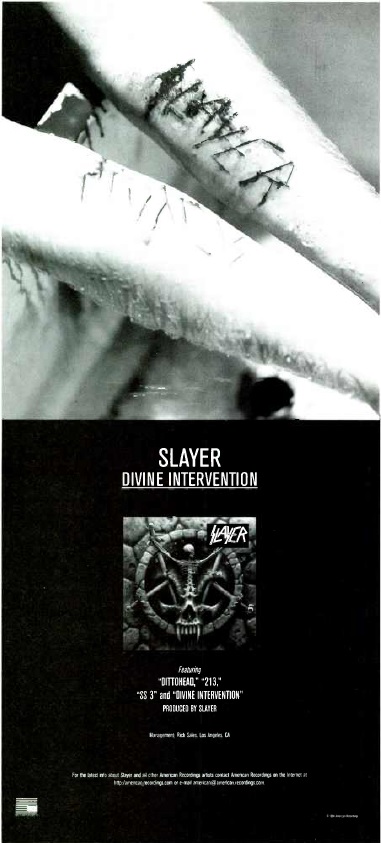
As had been the case since their Def Jam debut album Reign In Blood, Rick Rubin was involved on the album, but it was to a much lesser capacity than it was back in 1986. In an interview of Slayer through a Slayer Tour Special filmed in Ireland for MTV’s Headbanger’s Ball program, Kerry King refers to Rubin as “phantom producer” as he had minimal involvement. One thing of note that Rubin did try to sway for the album had to do with the visual presentation. Rubin wanted a photo that had been taken of a Slayer logo carved into a fan’s arm to be used for the cover (the fan in question being Michael Meyer), but the band wanted it inside the package as a bit of a surprise. At the end, it would be placed on the top surface of the compact disc. However, the surprise wouldn’t be very secretive, as the gruesome carvings would make its way into advertising that promoted the album.
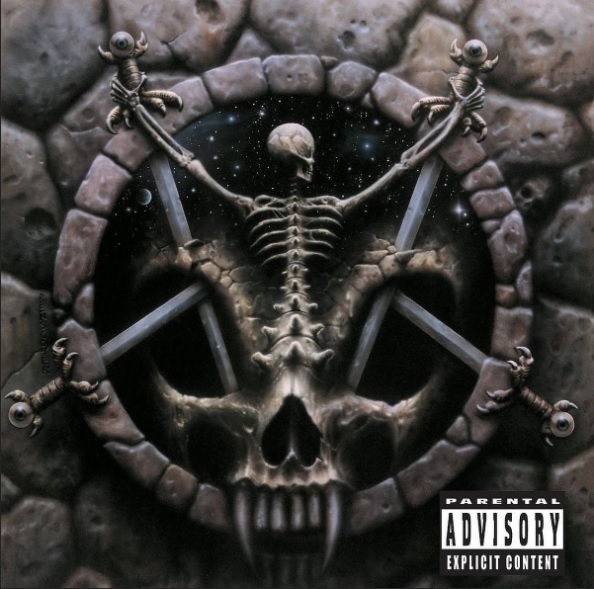
The stone skeleton and sword artwork they did end up using was the work of Wes Benscoter. He would go on to create more designs for Slayer as well as for the likes of Nile and Cattle Decapitation, but this was an early work for him. Prior, Wes was credited for Hypocrisy’s Osculum Obscenum and Sinister’s Diabolical Summoning, but I don’t see anything else. I don’t know how the cut-up arms would have played on the cover. Would it require more graphical enhancements? Maybe if there were higher definition photographs that could have been used, it would have made a strong cover image, sort of like how the guy getting punched in the face on the cover of Pantera’s Vulgar Display of Power became iconic. I’m sure this image would have needed to be censored in order for Divine Intervention to be stocked in certain retail outlets, so that might have been part of the discussion. This Benscoter design is what I’d call an effective safe bet. I find it in line with some of the different incarnations of the band’s logo, looking particularly to the shields that formed a pentagram shape and in combination with the eagle in stone. Of interest, the Slayer typeface logo is not featured on the album cover for the second consecutive time on a studio album, though a sticker of one would be featured on the outer wrapping.
Musically, the most important aspect, you might have expected a sizable shift in sound coming off the largest gap in their career at that point without releasing new material. Some of the coverage surrounding the band at the time could have made it seem that way. Vocalist/bassist Tom Araya told Hit Parader in the March 1995 edition of the magazine, “We haven’t been staying in the same place musically. This album goes places we’ve never been before, but it does so with the unmistakable Slayer edge.” I wouldn’t have had any leg to stand on to evaluate such a statement when I first heard the album. Divine Intervention was just the second Slayer album I ever owned, and the first of which that was entirely made up of original songs. My first Slayer album was Undisputed Attitude, where only “Gemini” was penned by the band along with a pair of songs (“Can’t Stand You” and “DDAMM (Drunk Drivers Against Mad Mothers)”) from Jeff Hanneman’s old punk band Pap Smear.
Regarding the album’s writing process, guitarist Jeff Hanneman described in issue 13 of Pit magazine that “Kerry and I decided to make this album a little faster. We decided over two years ago before we even began working on it. I show Kerry my riffs, and he’ll show me his. Then we decide what sounds good together. If the riff sucks, we throw it away. And the next thing we know, we have a Slayer song.” I’m sure other than the dedication to speed (which doesn’t always show on this album), this doesn’t seem different from any other description of making Slayer songs I ever heard from either Hanneman or King. Some albums, one or the other have more credits, but despite Kerry King having his name on more of the songs than his guitar counterpart, they both always knew what works musically in the context of Slayer. The writing credits for the music has nine songs featuring King’s name, and five including Hanneman’s. For lyrics, six songs for Tom Araya, five for King, two for Hanneman, and even newbie Paul Bostaph gets one on a four-way split credit for the album’s title track. I’m trying to think if I’ve ever seen that many names attached to a lyric in metal or rock music before.
What did I think of the album when I first heard it? It was certainly enticing enough that I sought out more of their albums, I can say that much. I could tell right away that Bostaph was a great drummer. I didn’t even have Dave Lombardo as a measuring stick to compare him against, but doing so is a disservice to his skills. He sounded like a man on a mission to make his presence felt through that intro on “Killing Fields” to lead off the album. It’s like what Judas Priest did a few years earlier on Painkiller, with new drummer Scott Travis’ now iconic intro on that album’s opening title-track. Bostaph really didn’t need to prove anything to anyone, as you could tell through Forbidden that the man had talent.
Like what Tom Araya expressed to Hit Parader, I agree that the songs are faithful to what the band stood for while bringing in some new directions. Focusing on one song that strays from the norm, we’ve got “Serenity In Murder”. Not so much subject-wise, but musically and with Araya’s monotone, spoken-word verse. I guess there were mild hopes for this song as a video was made for it. I’m not sure if the sum of the ingredients used here would have ever potentially launched Slayer into the next level like a Metallica, but a collection of songs closer in spirit to “Serenity In Murder” (more groove-oriented) would eventually come in 1998’s Diabolus In Musica, an album that would also make for a nice retrospective deep-dive. Ultimately, the band never really had that in them to make that mainstream jump, and that’s part of why they’re so beloved by a wide cross-section of the metal community.
As a strength, I’d make the argument that Divine Intervention was their most punk album up to this point in their career. They had the concise element down in song length terms on Reign In Blood, but I think sonically this album is rougher around the edges with a lack of polish or cleanliness, and the speed and lyrical nature of “Dittohead”, “Circle of Beliefs”, and even the catchy “Fictional Reality” gives the album a lot of crossover potential with punk fans. Maybe not as a whole, with several songs going slower and moodier as well, but even hardcore punk legends Black Flag would do slower material on occasion, and they are considered punk through and through. And even Slayer do slow things down on the album, it shouldn’t have been too surprising for their fans. The title track, for instance, is in a similar vein to Seasons In The Abyss’ title-track, taking a significant amount of time (in Slayer’s standards) to get from the intro to the vocals, and getting quite intense without approaching high beats-per-minute.
There are certain take-aways from the album I had on initial listens that I maintain today. The mix is a good reason why this album gets knocked, I’d think. Compared to all that preceded it, it’s a bit muddy. It seems to be not mixed to the band’s liking either, as Kerry King has criticized it on more than one occasion. The rhythm guitar tones don’t sound as crisp as their initial Def Jam / American album trilogy that I’d discover later on. Furthermore, the two tracks that close out the album (“213” and “Mind Control”) don’t stick in my memory quite like the others. In that regard, I suppose it’s a slightly front-heavy album to my ears.
All that aside, we still have a very worth-while album for any metal fan’s collection. When listening to Divine Intervention nowadays, having a greater familiarity with Slayer’s catalog, it seems like just another Slayer album. And that’s fine! Nothing too radical to rock the boat, but it still has an identity unique among their albums.
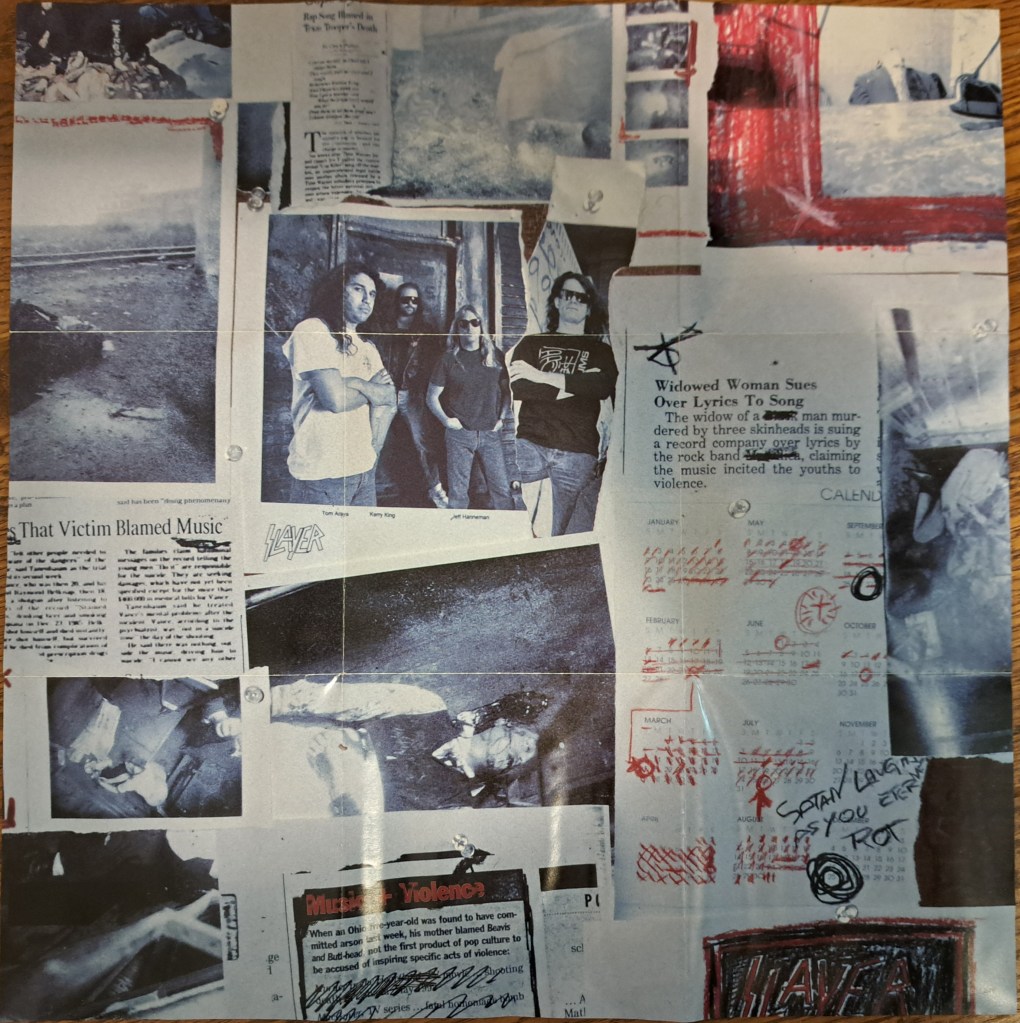
Thematically, you get what you’d expect from the band in terms of subject matter and tone. Not much of the Satan stuff of the early years of the band, and more on the atrocities of mankind and of specific individuals or murderers that their lyrics had already been gravitating towards. The tone of the overall package layout capture as much, with imagery hinting at something a serial killer vibe might obsess over. In this case, read carefully and it focuses on the evil that is Slayer themselves and other such harmful music. The newspaper clippings are very amusing, and the ripped apart combination of promotional pics to reflect their current lineup is a nice touch (more up-to-date photos of the band also make up part of the package).
How was Divine Intervention received back 30-odd years ago?
I began by looking for more mainstream reviews that immediately followed its release, but I’m not sure that those reviews would have been of great help. For instance, I stumbled across some excerpts from Rolling Stone magazine’s review. While it was rather praising of the album, some doubts of the review’s legitimacy were raised in a rather interesting list of the publication’s 500 worst album reviews that was shared by a user on RateYourMusic.com. The same magazine had years earlier apparently slapped a 2-star rating on Reign In Blood. I couldn’t find a more concrete reference to authenticate that rating. However, they did throw a 1-star review towards South of Heaven, so… yeah… maybe not a great source to go to for takes on metal music that don’t age like milk. Therefore, I diversified my search, and pulled some discussion of the album from some more unexpected sources.
Here’s a weird one to start on: Bass Player magazine. Their March 1995 review, naturally, takes a bass-centric focus, stating “his parts are practically nonexistent (even with headphones), earning him a high score on the Kip Winger “hold-a-bass-and-pretend-to-play” scale.” I found the discovery of this review amusing because bass is one of those aspects of Slayer that their fans tend to let slide. As someone who plays bass, they were never a band I went to in terms of learning their material. Araya’s bass parts seemed to simplify significantly when he went from playing with his fingers to using a pick. If the vocals are up to snuff, which they are here, then I don’t really factor the bass parts into how I view Tom’s overall role in the band. Also, I’m not sure if the Kip Winger (of Winger) knock is totally justified, but I guess there’s something to say about the efficiency of the writer’s critique (Scott Malandrone) by taking two men down at once.
Slayer are one of those bands that always seemed to have one foot in the underground while being a borderline household name, which is why I find hearing what the average Joe thought of the album particularly of interest. On that end, grass-root fanzines and college student-penned publications make for an interesting exploration. The fourth edition of Private Death’s 3-out-of-4 review mentions “most of Divine Intervention will confuse the casual listener with that infamous third album (Reign In Blood)”, meant in part as praise despite also implying it’s merely the status quo for them. Lambda (Laurentian University’s paper out of Sudbury, Ontario) writer Steve Martinovich may have raised more than one set of eye brows when calling the album “Slayer’s best album to date”, failing to find a single song he disliked on an album “as dark as any before”. David Carlton wrote in a review for Spoke (Conestoga College’s paper from Kitchener, Ontario) in their April 3, 1995 edition that “Guitarists Jeff Hanneman and Kerry King are at their finest on this album without the thoughtless, indecipherable and feedback-laced guitar solos of previous endeavors. The rhythm sections are crunching in distortion and the leads are cleaner and more note- worthy than before.” Thinking of Slayer as more of a force of rhythmic energy, I rarely dive too deeply into their soloing. I tend to write much of King and Hanneman’s leads off as “noise solos” (albeit “effective noise solos” for their brand of metal), and what they play on Divine is as effective as ever.
For an album that is just their sixth full-length effort, you would think that more of these song would have had more staying power in their live sets. To the best of my knowledge, “Dittohead” is the one concert staple from this album. I could get into a whole rant about how I dislike the lack of setlist variety that many artists provide their paying audience, but if any song off Divine is fitting of a Slayer show, “Dittohead” is the one. Great energy, and very easy to pop into a set with a 2:31 run time (which I’m sure would be sped up further in most live performances). The lyric “here in 1994” dates the song on a careful listen, but when I saw them on their “farewell” tour in 2018 (who knows these days, right?), I’m pretty sure Tom still sang it that way. It’s just amusing that a late-September release date could have granted the track roughly three months of relevance. Still, why just largely this song in their set? I can see a slower song like the title track being somewhat polarizing to the speed freaks in the fan-base, but you can’t convince me that “Killing Fields”, “Sex.Murder.Art” or “Circle of Beliefs” wouldn’t get the crowd revved up on any given night.
Slayer were already at this point in their career where they had built up a great touring arsenal of songs across their existing five studio albums and an EP, which was proven to work well cohesively when compiled on their Decade of Aggression live record. To have faith in your new material, even with Slayer still being young men in their early-thirties, is admirable given what preceded it. Looking back on the Divine Intervention tour, they definitely were behind it at the time. The Ireland Headbanger’s Ball special interview outlined that they started working in three of the album’s songs prior to its release, then played five, then building up to seven songs. Looking at available setlists from their shows as provided to ConcertArchives.org, starting from their Milwaukee Metal Fest performance in August of 1994 through to their Castle Donnington gig on August 26th of 1995, they played “Mind Control”, “Divine Intervention”, and “213” initially, then added “Dittohead”, “Sex. Murder. Art.”, and “Killing Fields”, as the proper tour of the album progressed. “Circle of Beliefs” would replace “Mind Control” in later gigs of the tour. The surprising omission from the set is “Serenity In Murder”, the very track for which there was a single and music video. I’m not sure why bands end up doing that sort of thing. Was the chosen single a label or management-selected thing? Maybe the live set was under band control, and they didn’t prefer it to the other tracks played. Surely there would have been one newly-minted Slayer fan in 1994 that was pulled in by their “Serenity In Murder” video that was disappointed to not hear the song on that tour. However, it may not have been a widely played video.
A home video would come out around this time, Live Intrusion, which I never had the pleasure of watching until it received a DVD release in 2010. It captures the band nicely on the tour, with the live footage being directed by NFL Films, who also did Dio’s Sacred Heart “The Video” a decade earlier. Of interest, among the crew’s behind the scenes camcorder footage is the aforementioned bloody forearm logo carving. I also appreciate the inclusion of the set-closing Venom cover “Witching Hour”. That particular performance had the band joined on-stage by members of Machine Head, who opened for Slayer for a good portion of the tour.
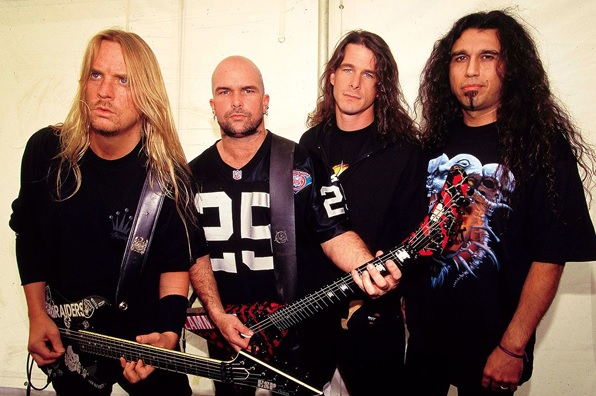
What’s left to say about this era of Slayer? I never mentioned Kerry King’s coming to grips with his impending baldness. Great look! Was he inspired by Scott Ian? Tony Levin? Telly Savalas?
I guess we’re done here.
 Armchair Maestro