

What I thought was lost for good has now been found!
We’ve all had similar experiences in life where there’s something you’ve owned or used previously, be it an album, movie, video game, or some other item that you can remember in just about every detail imaginable, but the name escapes you. You can ask friends, relatives, coworkers, consulted discussion forums such as Reddit, but despite your best efforts, you are unable to find what you are after.
In a particular case for me, it was a book. Many of us have heard of the “Satanic panic” or recall a point where religious groups rally to protest or call for a ban of something that they deem goes against their faith’s teaching. You’d have the likes of the Westboro Baptist Church protesting funerals (often due to their stance against homosexuality), rallies against films like The Last Temptation of Christ over how Jesus was portrayed, and organized Harry Potter book burnings as a few real-world examples. While I was aware of such occurrences, I never had any first-hand exposure.
There was a period in my life between the ages of 16 to 19 when my interest in rock and metal music was accelerating to the point where I’d look to any website, magazine, or book about music that I could get my hands on. It was much more difficult in the early-2000s to accumulate music at the rate you could read about it than it is today, but I still liked to build up a knowledge base.
Through one book in particular, I learned a lot more than I bargained for.
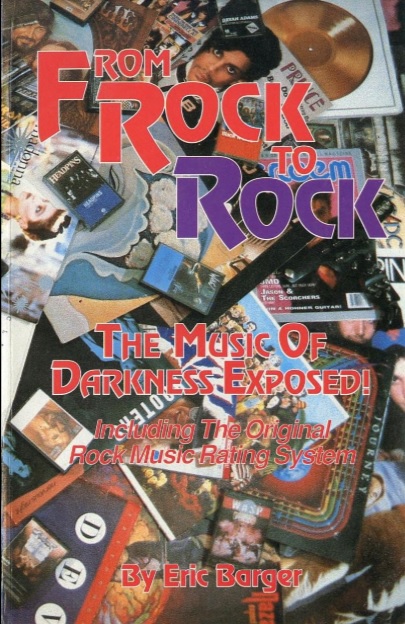
From Rock to Rock: The Music of Darkness Exposed was a book originally obtained at a nearby but now-defunct record store, Star Records, in Oshawa, Ontario. It’s the store from which I bought the bulk of the first records in my collection. Vinyl was considered a dead format at the time, so prices were reasonable. On one trip to the store, I grabbed my copy of this book, thinking I’d at least get a kick out of the subject material. That mission was undeniably accomplished. I only owned it for a few years, getting rid of it once the book’s spine snapped and pages started falling out.
If you have a gander on Internet Archive or the search engine of your choice, you too can find this book. I stumbled upon this book when I was doing research for a future post under development, looking to learn more about a particular Black Sabbath album. Black Sabbath is a natural fit for a book of this sort, so it’s not a surprise that they were included within. They were also included in many other books of this sort I happened to read as a teenager, including another (whose title also escapes me) that I found in my college’s library that pointed out alleged backwards messages “it’s fun to smoke marijuana” in Queen’s “Another One Bites the Dust” and some “my sweet Satan” talk in Led Zeppelin’s “Stairway to Heaven”. Books of this nature opened a whole other world to me of music criticism through a religious lens, which is kind of surprising considering that I went to Catholic schools from kindergarten through grade 12.
The author of From Rock to Rock: The Music of Darkness Exposed is Eric Barger. I knew nothing about the author when I found this book over twenty years ago, but from the sounds of things, he’s still out there doing his thing. He’s got a website up with links to many of his books, appearances, interviews, and newsletters. He’s been keeping modern by bringing his voice to podcasts, such as this appearance on the Serpents & Doves podcast in a discussion about the evils of Halloween.
He even has a book for free on his site that overviews his personal journey. It’s titled How I Came From Rock to Rock: The Testimony of Eric Barger. My first thought was either this is an updated version of the book I grew up owning or that he REALLY loves the “From Rock to Rock” phrase. I was interested in reading this free book (at only 24 pages, it’s a very quick read), as I wanted to see if his tone had changed in the years that followed the publishing of The Music of Darkness Exposed! It didn’t get into a discussion that targeted major rock bands like the book I grew up with, rather more exploring his journey to religion. Not so much of what I want to focus on, but it emphasizes his backstory with details he left out of the book of focus. It does touch on the ever-common experience of The Beatles performance on The Ed Sullivan Show as his gateway into rock music on top of discovering other stars of the day such as The Dave Clark Five and The Supremes. He had a band of his own called Sluggo, which as it turns out, is a rather common name for a band. He also had another band called Shaker, so ditto for commonality there, making it hard for me to dig for songs or even samples of either group. From there, a slippery path commenced down the sex and drugs portions of the trinity, and how he found God after a series of personal struggles.
I don’t want to speak too much of his story, as I’d suggest you read it to get better context than I could ever paraphrase. I’ll just say that his is one of many stories showing that some people (often well-meaning and good people) are more susceptible to certain vices entering their lives than others, and religious faith can be a way for someone to put their life on a better path, but that isn’t the solution for everybody. I’m sure that Eric Barger’s teachings and From Rock to Rock: The Music of Darkness Exposed in particular helped some people examine their Christianity and the Bible. I’m also sure that it also drove people further away from religion. I don’t consider myself to be anti-religion or against having faith in a higher power, but I fell far more in the latter category than the former.
From Rock to Rock begins with a statement from the author, which sets the tone pretty well for the entire book:
“Listening to rock music never sent anyone to Hell. No, it simply teaches people how to get there, destroys God’s desire for one’s life, produces idolatry and conditions those who listen with satanic ideals.
Certainly, not every song on rock and country radio is evil. They don’t all say “worship the devil, take drugs, kill your parents and commit suicide.” If they did, who would listen?
It’s every third, fifth, eighth, fifteenth or twentieth song that teaches the adversary’s goals explicitly. Many of the other songs may not be as blatant, but they still fall far short of the standard which God is pleased with. And that’s really the key isn’t it? Who and what are we identifying with? What are we advocating?”
There’s an association with rock music that goes on throughout the book to sex, drugs, and the occult as if it’s a natural pairing. In cases, that could be fair enough, I guess. Songs are written about a wide-spanning range of subjects, so there’s a song out there about pretty much anything you could think up, from serial killers to cereal eaters. I can’t think of any major music artists that have emerged in more recent times that have been transparently dabbling in the occult or Satanism, but I’m sure sex and drugs are on the menu for many musicians as they are in wider society. Regardless, my issue with many cases of lyric analysis is where intent come into play. If you write a song about Nazism, drinking and driving, domestic violence, or whatever else, that doesn’t mean you are encouraging listeners to follow the behaviour of those being sung about. So why should having songs with such content be frowned upon? And what does make for appropriate song subject matter?
Before I re-visited the book in recent days, here are some areas of focus that I could still remember from my reading of the book twenty years ago:
- He points out hidden details in Dio’s logo, spelling “devil” when turned upside-down (looks like a stretch to me)
- There was discussion of Prince’s music, specifically the song “Darling Nikki” that kick-started the Parents Music Resource Center (PMRC) committee.
- He definitely had no love for W.A.S.P. or Venom (not like I’d expect him to)
The book emphasizes early on that there are “Ten Elements of Rock Music” of which to be concerned:
1. Rebellion
2. Violence
3. Nihilism/Despair
4. Escapism
5. Drugs/Alcohol
6. Sexual Promiscuity/Perversion
7. Suicide /Murder
8. Occult/Paranormal Activities
9. Open Satanic Affirmations
10.Anti-God/Anti-Christian Blasphemy
Many of these points I can understand someone who has become deeply religious taking issue with. The main one I’m uncertain about is escapism. Escapism, or “habitual diversion of the mind to purely imaginative activity or entertainment as an escape from reality or routine” to go by Merriam-Webster’s descriptor, can be bad at the extreme end of things where you’re shutting out all your daily responsibilities. It doesn’t get that far in most cases. Many common hobbies can be considers forms of escapism, listening to or playing music aside. What about video games? If Christians considered video games to be all that bad, then why were those Bible Adventures games ever created? Reading can be escapist, particularly with regards to fiction. What point is there in reading about events that never happened? I wouldn’t say that, but I’ve heard such things said before, whether in jest or not.
Those Ten Elements of Rock Music are really the foundation of From Rock to Rock. To drive the points home, a substantial amount of cases involving popular rock bands are highlighted in the book.
Here’s one excerpt in particular that has stuck in my mind for years, a portion where he discusses the metal band Queensryche.
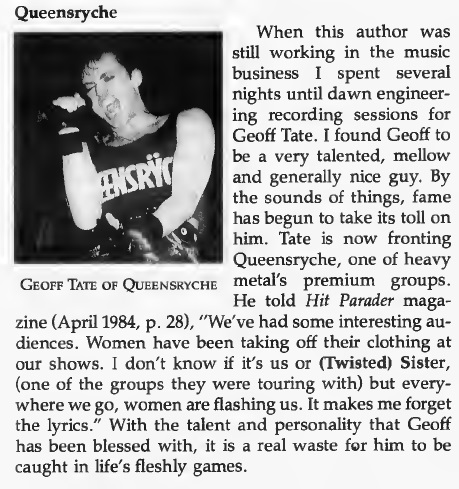
A hardcore Queensryche fan would probably get curious as to which sessions the author engineered that Geoff Tate was involved with. Sounds like it wasn’t Queensryche, but was it The Mob? Myth? It could have been Babylon, as it does seem like a quasi-religious name, but I don’t know the recording history of any of those groups.
Nonetheless, while hoping that Tate steers clear of “life’s fleshy games”, the author does profess the vocalist came across as a “very talented, mellow and generally nice guy”. Isn’t that enough? If Tate’s good character was often on display, that should already do him well in life. The main gripe here is that Tate stated in interview that a woman baring her chest at a concert can cause him to potentially perform poorly. Who wouldn’t such a thing happen to? Would the Pope not be the least bit distracted if someone rubbed their bare breasts against the glass of his Popemobile? What I’ll credit Barger with here is that there is at least some complimentary language used towards one of the included musicians’ talent and character. I just wish there was more of it.
Here’s an interesting figure this book drops: Michael Jackson’s “Thriller” video was “once voted the most violent video of over 900 viewed by the National Coalition on Television Violence”.
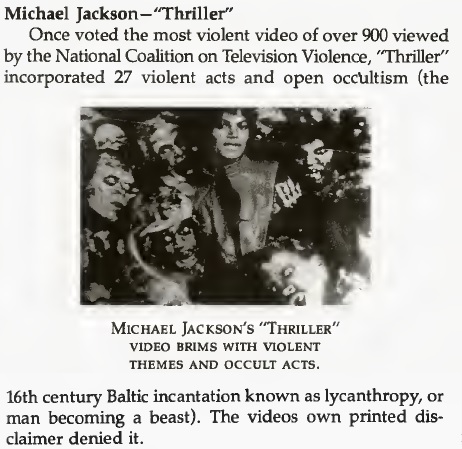
Does the coalition in question exist today? I’m not sure, but a founding member of the organization (Dr. Thomas Radecki) was sentenced to 11 to 22 years of prison time in 2016 for exchanging medication for sex with female patients, and had previously had his license revoked in the ‘90s on similar grounds. Upon learning of this, I frankly stopped caring. Still, as it had been years since my last viewing, I had to watch the extended version of the video again. Of interest, it was preceded by a disclaimer from MJ himself stating he does not endorse the occult.
Is this truly the worst they could find out of 900 music videos? And how did the coalition find “27 violent acts and open occultism” in this video? I’d love to see the complete list. If YouTube existed them, how much higher than the current 1.1 billion views would this thing have reached with all the repeat watchings it would take to spot them? Sure, transforming into a werewolf (and later a zombie) has your occultism covered, but did they count each creature as a separate case? Is the car running out of gas violent? I’d really want to kick myself if that happened to me! Does singing at a young woman count as occult if you factor in the lyrics? Is eating popcorn violent? Maybe is you’re being passive-aggressively loud about it, but I’m not giving up one of the great GIFs of the world no matter your interpretation.
A rare example of a Christian group does come up with DeGarmo and Key.
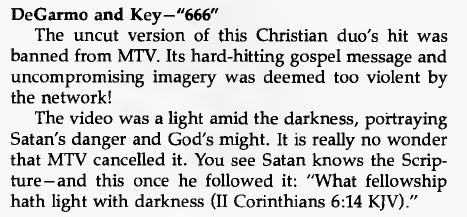
I recognized the name of the group, but doubt I’d seen the video until now (it’s actually quite a catchy tune!). Was the “666” video banned from MTV, or did people stop requesting it? I also wonder why they get praise when I’m sure multiple artists that get called out in this book have had very similar themes in music videos or otherwise positive messages. I’m under the impression that song’s lyrics really need to make it blatantly Christian to get a pass, thus the spotlight in this case.
A video like Dio’s “Rock ‘n’ Roll Children” comes to mind. It begins with a man preying on a teen-aged girl, quickly leading into a conversation between her and a male friend about “selling out” by getting a job. We then see flashback or fantasy sequences with each of the kids in various social and family situations into which they don’t fit, one of which started out as somewhat of an idyllic Christmas sequence that goes awry. They aren’t exactly being chased by the devil, but they are escaping what they see as rather dark situations (such an abusive father figure) in look for something more positive. That pursuit is pictured as rock and roll, but it’s really just a metaphor. It could just as easily be Christianity, and most certainly a more loving and encouraging environment than that in which they are escaping. The song doesn’t directly say Jesus’ name, but the video nonetheless paints a picture that these two kids are certainly in need of some sort of help. If this was a song by someone other than Dio, perhaps it and the video would have been seen as one having Christian morals.
Here’s an excerpt pertaining to a band I’ve become more heavily acquainted with in just the past few years, Blue Oyster Cult.
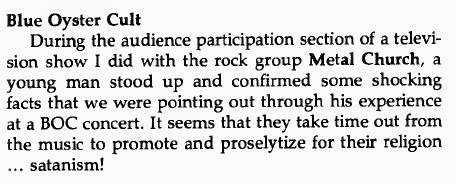
Vagueposting appears to have been a thing prior to the internet, though done in print form. These 57-words was all this section contained. It would have been eternally helpful if the name of the show on which Metal Church appeared was mentioned so we could get more than a crumb of context.
The author does make further references to Blue Oyster Cult later on in the book, but in terms of taking a break in their concerts to praise Satan, I’d appreciate not having to do my own research when it was brought up without a clear source. I feel the need to break this down like Commander Riker grilling Lieutenant Worf in the false-reality Star Trek: The Next Generation episode “Future Imperfect”. What year? What tour? What venue?
Some of these bits I could read in Alan Partridge’s voice, a character often prone to taking lyrics too literally, such as the following analysis of Sammy Hagar’s song “I Can’t Drive 55”.
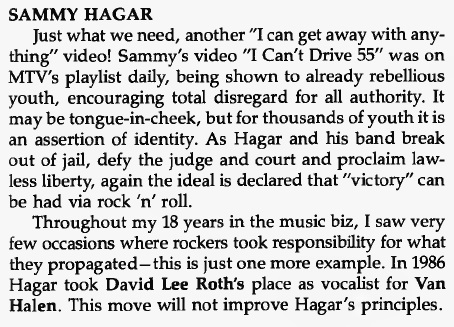
I’m sure the song can be taken metaphorically, but let’s look at the lyrics in a literal sense.
The chorus goes as follows:
“Go on and write me up for 125
Post my face, wanted dead or alive
Take my license, all that jive
I can’t drive 55”
You could just as easily take those words as a PSA from the opposite, pro-law enforcement perspective. Based on various discussions I could find online, the “125” is either a reference to the dollar cost of his speeding ticket or that he was going absurdly fast at 125 miles per hour. Violating speed laws repeatedly or being wanted for reckless driving (potentially causing injury or death) could make him a highly sought-after fugitive, so being on the run would not be an ideal way to live life in the slightest. Even on the lighter end of speeding, with a driver’s license getting temporarily suspended after multiple violations, he absolutely could NOT drive 55. Not when you have to trade your car keys for a bus pass.
Perhaps the music video does make Hagar look too cool despite the fact it actually does depict him being punished for his actions. They should have added a final act where it shows a dishevelled Sammy being thrown off a bus after unsuccessfully arguing over an expired transfer.
I’ve got to put my nitpicker’s hat on for claims like this one about The Dead Kennedys.
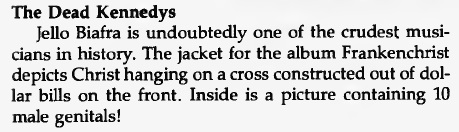
No, the album cover of Frankenchrist did not depict “Christ hanging on a cross constructed out of dollar bills”. Frankenchrist had a photo of Shriners members driving those cute little cars. The cover the author describes was used on the In God We Trust, Inc. E.P. You may not think it matters since he at least got the band right, but it does. It glosses over the message that the Winston Smith-created crucifix image evokes, and that would be that there are those out there that exploit religious beliefs for financial gain. Not that I’d say releasing a book like From Rock to Rock is necessarily doing that, but I think it would also even be in the interest of Christians to call out those cases in which it does apply (see Jim Bakker).
I don’t actually own Frankenchrist, so no comment on if there are ten male genitals or if Barger miscounted.
The biggest shock to those familiar with ‘80s pop music may be the book’s section on Lionel Richie.
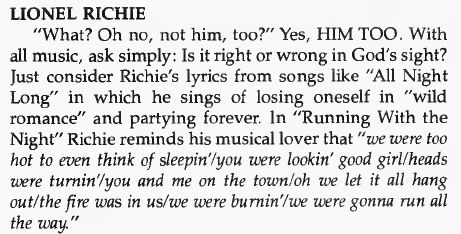
“What? Oh no, not him, too?” Yes, HIM TOO.
One of the book’s great lines! I’ve always considered Lionel Richie’s songs to be tame and not terribly racy, even as a very young boy. When I was around three or four years old, my favourite song was “Dancing on the Ceiling”. I think I just fell in love with the lyric on the surface level, “oh, what a feeling to be dancing on the ceiling”. It’s like Mr. Richie could read my imagination and how absurd it would be to defy gravity like that. Perhaps I had it all wrong. Maybe this was a reference to a sex position I couldn’t understand at the time and, frankly, one that is still lost on me.
Even looking at his quotation from the “Running With The Night” lyrics, lines like “we were too hot to even think of sleepin’” or “we were burnin’”, I don’t get what the fuss is about. Are you not allowed to be physically attracted to someone while also being religious? Plus, I’ve also been so hot in bed that I couldn’t think about sleeping, and I didn’t even have a woman with me! Air-conditioning issues, am I right, folks?
I just know you’re wondering what the most obscure band that is covered at length in this book, right?
That honour goes to Rigor Mortis.
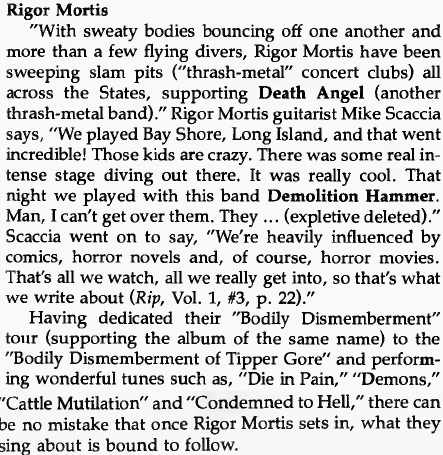
Sure, their debut album was released through Capitol Records, but they didn’t stick around on a major label for too long. If issue was taken over some of their lyrics, you could slap a sizable appendage to this book once the likes of Cannibal Corpse and Deicide hit the metal scene.
What I remembered most of all about this book was the review system, which factors in “The Ten Elements of Rock”, branching those points out into twelve categories.
Those are:
- Occult Influences
- Drugs/Chemicals/Alcohol
- Cultic Influences (not a typo, though I’m not sure if “cultic” is a real term)
- Sexual Overtones or Perversions/Hedonism
- Rebellion/Violence/Vile Language
- Satanic/Demonic Themes
- Blasphemy/Anti-Christian Proclamations
- Nihilism/Escapism/Surreal Fantasy
- Murder/Suicide
- Subliminal Messages / Backwards Masking
- Defunct / No Longer Performing
- Unresearched / Incomplete Research
These probably could have been whittled down further, and why defunct artists need their own distinction I have no idea. Could such a tome as this book take credit for the downfall of certain artists, leading to future disbandings? Or for a band to rethink their image, and turn Christian? Regardless, there are numerous artists that were inactive at the time the book was released that aren’t branded as such.
As it stands, you’ve got 44 pages on this list, which covers over 1000 different artists. That’s fairly impressive for the pre-internet age, I must admit. Being young and in the early stages of my true music fandom, I both appreciated the list’s expansiveness, yet was nonetheless keen to put it to the test. As I was getting into more and more obscure music, I’d use this list as a tongue-in-cheek reference guide as I’d spot different bands and albums that were new to me.
They’re flagged as a number 5, Rebellion / Violence / Vile Language. I can live with that.
Same label, so I guess I can pray a few more rosary beads nightly to make up for it.
HA!!! They didn’t even list Death! They have Blessed Death, Death Angel and Death Cult, but no Death. Sweet! I’ll let them corrupt me until instructed otherwise. I hope nobody snitches to his staff to get them added in an updated edition of the book.
On that note, there were actually plans to make this book, or at least The Rock Music Rating System, a regular thing.
“Each updated version of this guide will reflect the changes that have taken place since the last printing.”
Did he ever provide updates? Maybe in newsletter form rather than a full book? I’m not sure. It would be pretty straightforward nowadays to grow a very thorough online database to grow the list ten-fold or greater. You could cross-reference the violations on the list to lyrics, album covers, stage performances. Part of the growth of such a website could even come from non-Christians that are legitimately big fans of a variety of genres and want to flex some lyrical knowledge, if that’s how they want to spend their time. You could get more fulfillment out of that than being a Wikipedia contributor.
Here’s a sample showing how some of the artists were graded.
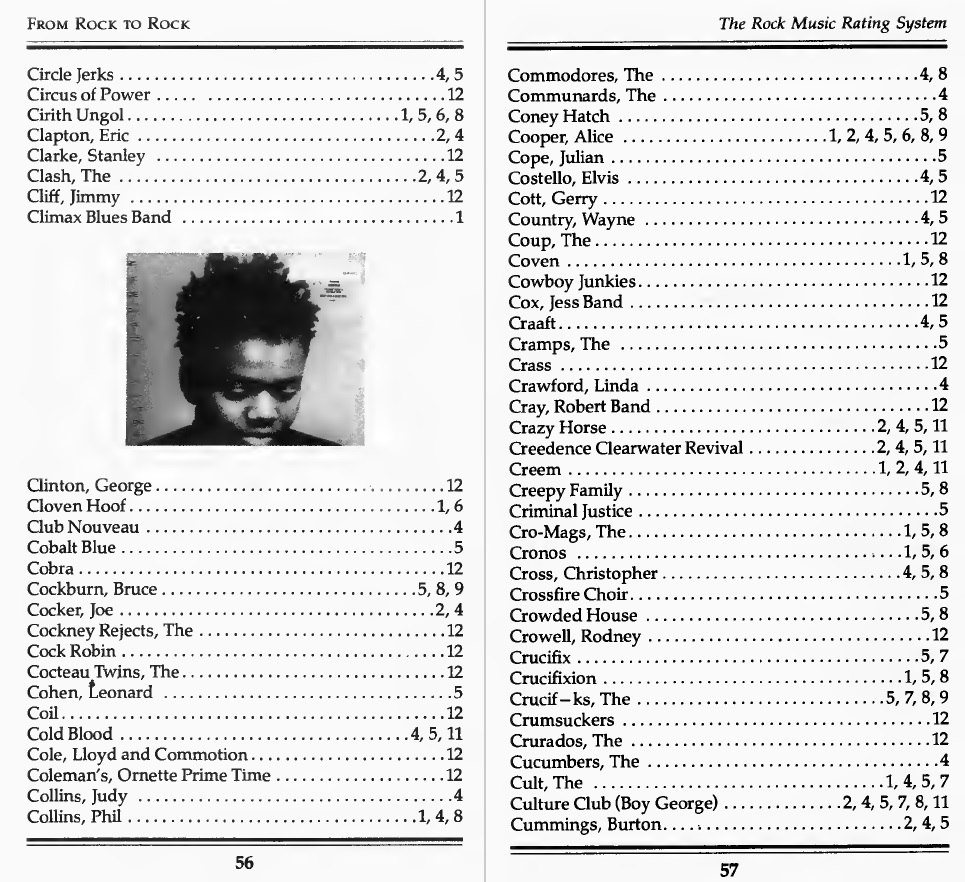
Which artists accumulated the most elements of rock?
That would be the 10 each given to Mick Jagger and The Rolling Stones, who were listed separately given Jagger also had a prominent solo career alongside it. Unusually, they tag the Stones as being defunct, which is unusual given that Steel Wheels had only just come out in 1989.
Regarding the amount of these thematic violations that these artists accumulate, is there an amount that would be considered to be acceptable? Is any one of them considered not too bad? How are we to know that those not included on the list passed the purity test? I guess there’s no way of knowing without enough man power to collect information, and there’s always going to be something that slips through the cracks.
Regardless, I gave the list a very good read, and found some more noteworthy rock bands that did not make his list. Despite the fact that instrumentalists like Paul Bley, Ornette Coleman’s Prime Time, and Keith Jarrett are mentioned, I’ll stick with bands with regular use of vocals and lyrics that were fairly well established in the western world by 1990.
In alphabetical order, some notable names that I couldn’t find include:
- Adrian Belew (his former King Crimson band mate Robert Fripp was included)
- Captain Beefheart
- Caravan (and their songs often contain sexual innuendo)
- The Byrds (as well as David Crosby and Roger McGuinn’s solo work)
- Ray Charles
- Cheech and Chong
- Danzig (same goes for Samhain, but they included Misfits)
- Willie Dixon
- Brian Eno
- Faith No More
- Funkadelic (same goes for Parliament and Parliament-Funkadelic)
- Gentle Giant
- Humble Pie
- Ian Hunter
- Ice-T (very surprised by this one!)
- Jane’s Addiction
- Japan
- Killing Joke
- B.B. King
- King Crimson (ok, that omission is personal!!)
- Ministry
- Minor Threat
- Peter Murphy (his old band Bauhaus, or “Bauhas”, did get included)
- Dolly Parton
- Screaming Trees
- Jane Siberry
- Sisters of Mercy
- Small Faces (or even Faces)
- Sonic Youth
- Soundgarden
- Swans
- Talk Talk
- Television (or Tom Verlaine)
- Traffic (Steve Winwood is here, though)
- Tom Waits
- Van der Graaf Generator (or Peter Hammill)
- Scott Walker
- The Yardbirds
Now that’s quite the eclectic playlist, wouldn’t you say?
Sure, some of the above may have been better known outside of the States, but that’s nothing a bit of networking couldn’t have solved. Nonetheless, I really tip my cap to Barger and his team for putting some pretty obscure artists on this list. Very thorough given relatively limited resources, I’m sure. For instance, check out these names: Agent Steel, Demolition Hammer, Helstar, Jag Panzer, Nasty Savage, Meliah Rage, Zoetrope. He must have had talent scouts from Metal Blade and Roadrunner Records informing him on some of this underground stuff!
Here’s a couple bands that my decades as a metal head put on my radar. “Doom metal” band Trouble are included in the rating system (for occult references and rebellion/violence/vile language), but there are many that have labelled them as a Christian metal band. Stryper are also not on the list, who are perhaps the more blatant Christian rock/metal band there has ever been. Perhaps this was known by those that compiled the list, yet there’s not even a mention of Stryper at all in a positive context.
A few other curious cases get brought up. They point out in the list while name-dropping rock band America that Dan Peek is now Christian. Does this mean that America’s music can be re-assessed from a Christian lens, or should one go from Peek’s point of conversion as far as where to begin? The list also mentions Kansas’ “pre-Christian” era. Could you narrow it down a bit for the audience? Is Leftoverture good for the soul (it’s certainly good for the ears!), or do we have to dig a little deeper? King’s X is in a similar category. They were widely embraced as a Christian band while never outright claiming to be one, but this connection took a hit once Doug Pinnick came out of the closet and their albums were removed from many Christian stores that stocked them.
One section breaks down a variety of symbols used in the art of many music artists. One of the biggest surprises among the array of the typical (pentagrams, grim reaper, the Southern/Inverted cross) is the peace sign. No matter the perceived origins or intent (if harmful), what’s a realistic percentage of people who would think of this symbol or of the “hippie” types that wear them as inherently anti-Christian? No many, I’d bet. Overall, I’ve never really dwelled long on this section of the book, opting to read the more direct discussions about different artists and albums.
Taking the book as a whole, I just don’t see how this would enrich one’s life as a working guide and list. For me, music greatly enriches my life, and I can’t think of greatly reducing the amount of music I listen to based on someone’s interpretation of the artist’s intent in their messaging. Even if you disagree with a musician’s visual aesthetic or their song content, I think encountering them via your own discovery would be of benefit. Working off of a list such as the one in the book could encourage keeping the artists at arm’s length without even having a working knowledge of why one should object to them in the first place. Additionally, I don’t think the author needed to tear down what others are doing in this exact fashion. I view a book like this one is like doing surgery with a machete rather than a scalpel. Is the mere mention of a taboo subject enough for an artist to be flagged for being in opposition to the word of God? Not all lyrics are an endorsement of their subject matter.
I do think criticism in the manner that this book does it, despite not agreeing with much of it, does have some validity. It is relatively easy and common to misinterpret someone’s words or an artist’s lyrics, and the author here attempts an interpretation of his own, which may or may not be of help depending on who the book reaches. However, the best source of lyrical interpretation and meaning is undoubtedly from the word of the songwriter. It reminds me of Twisted Sister vocalist Dee Snider’s defense of some lyrics of his own in front of congress due to the PMRC’s request at labelling albums deemed to have inappropriate content. In his statement and questioning, Snider reveals Twisted Sister’s “Under the Blade” came from their guitarist Eddie Ojeda’s pending surgery. The proper saying for surgery is more commonly “under the knife”. Does “Under the Blade” sound more menacing? I think it does, and reading through the lyrics the subject matter seems more exploratory than what you’d see in the confines of a hospital. However, as Dee Snider professed, it’s about the fears that come up regarding a trip to a hospital, where the imagination can run wild. Dee Snider has all the creative license to do what he wants, and the song is how he expressed himself and his thoughts on a real-life incident.
This sort of clarification has been said to death by many artists whose work is critiqued as Satanic, a bad influence, or is perverse in some fashion. We live in a rough world, so why can’t your art express that? While some of Snider’s statements regarding the PMRC or members of it may have been a tad abrasive, I have no problem with it. Snider did a great job defending rock music considering that he had been put on his back foot in a defensive stance, and was largely well-composed under such an audience. He shouldn’t have had to defend his songs in the first place.
With those on the offensive, such is the case with Barger or the PMRC, one wonders why. Protecting children seems to be a high priority here, something we can all get behind. That said, children will inevitably discover stuff on their own. As a parent, how could you tackle it? Say, for instance, your young child hears a song that has… lets say… adult-oriented lyrics. To be more modern, let’s say the song is “WAP” by Cardi B and Megan Thee Stallion. Going religious with it might not work, even if you believe in it and teach/preach it to your kids. It could be viewed as a general method of waving away something that they enjoy, assuming they found the track catchy in the first place. Maybe, as uncomfortable as it may be to discuss, sexually transmitted diseases may need to enter the discussion. Maybe highlighting the advantages that long-term relationships can have on a persons life rather than short-term, one-night-stand sort of encounters. I don’t know, it’s tough! As I review the lyrics myself, I don’t think there’s any discussion about this song that wouldn’t make me uncomfortable.
To be clear once again, my criticisms of Barger’s own criticism isn’t due to a hatred of Christian-based religions. I saw a Satanic preacher outside of a Dark Tranquility concert recently, and the crowd (myself included) found that to be even more weird than preachers on the opposite end of the spectrum. I grew up Catholic, and I don’t believe I wear any scars from my experience, as it was rather positive in general. My parents were both raised Catholic, and we regularly attended mass. That said, they weren’t outwardly religious aside from this. When I was a teenager, my parents would usually just roll my eyes at an album I picked up if it had any overt sexual, violent, or anti-Christian themes, but trusted that it won’t corrupt me because, well, they know me. They raised me, and raised me well. More of their parental guidance came when I was younger. When we’d go to the movies, we wouldn’t pick a movie that neither of my parents saw a trailer of. While I can quote my mom as having saying to us kids in an argument “it’s PG, Parental Guidance, and I’m guiding you to not watch this movie”, the rating itself was not gospel. Maybe something risque would slip through the cracks, such as the “she’s got a power tool in the bedroom” line in Mrs. Doubtfire, but no lasting harm done.
Anyway, I enjoyed exploring this book again. As stated earlier, I had seen a few other books that tackle mainstream music through a similar critical lens, but you know what books I never seem to come across? Books from a Christian perspective that build up certain bands/artists rather than looking for ones to tear down. What are some good, Christian bands to listen to, and how would one know the difference? It could even be done as a companion book to From Rock to Rock, where you could hold up more examples of wrongdoing that the bands placed on the naughty list, and contrast with what the Christian bands are doing right. An A to Z guide or directory of musicians professing to be Christian could be an enlightening reference for many.
In case I wasn’t clear, I’d propose that many of the artists featured in this book were rated unfairly. Could they be given a platform to tell their side of the story? You could probably get good mileage, and even a full book or two out of it, if you seek out members of some pretty recognizable bands that are Christian. In the popular punching-bag of heavy metal, you could start with names like Alice Cooper, Rob Halford of Judas Priest, or Dave Mustaine of Megadeth. There could be more common ground found there than anticipated.
Keeping with the times in which the book was released, I’d like to know if the author ever had any encounter with the “Straight-edge” movement that were setting roots down in the early 1980s hardcore punk scene. I have a feeling that certain political leanings that some of these artists hold someone like Barger might take issue with, but what about as a general principle? Surely seeing bands that can rock and that didn’t necessarily use religion as a reason to steer clear of harmful substances or unsafe sex is still a rather admirable rationale for choosing to abstain, no?
I also got to thinking of what an updated version of such a book would be. There’s been countless others to enter the music business in the last thirty-odd years. Who would make the book, and who would be spared? What is thought of the current wave of popular music with the likes of Chappell Roan, Taylor Swift, or Dua Lipa? Has music gotten better or worse over time regarding disregarding Christianity or “good living” in general? Perhaps there’s another podcast or some other place in which this is addressed.
—
I’ll put a request out there to anyone reading this. If you can find any books like this that dive into music in a similar way, please direct them to my attention. I’d love to read them, whether they are older or more contemporary.
Lastly, here are some of the works referenced as sources within From Rock to Rock (besides The Holy Bible) that I’d also like to seek out one day:
Backward Masking Unmasked by Jacob Aranza
Rock’s Hidden Persuader by Peters/Merrill
Why Knock Rock by Peters / Merrill
Truth About Rock Report

